

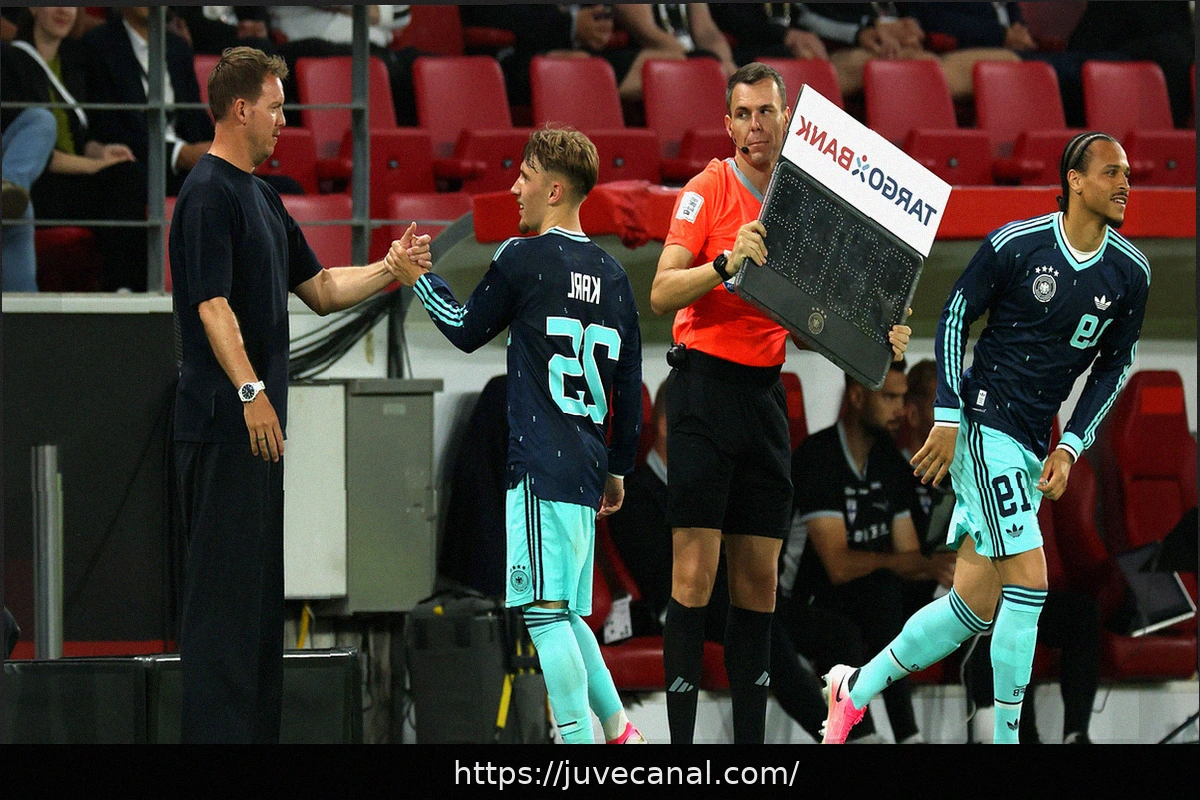
Although the 4-0 victory against Finland was comfortable, the German national team sometimes lacks tactical discipline. Julian Nagelsmann should consistently rely on young players and demonstrated the right instinct. Three key observations from the penultimate test match before the start of the 2026 World Cup in the USA, Canada, and Mexico.
Uli Hoeneß was Right: The German National Team Still Needs to gel
Head coach Julian Nagelsmann, captain Joshua Kimmich, and striker Deniz Undav were all satisfied with the 4-0 win against Finland in the penultimate World Cup test match, and rightly so. Kimmich stated in an interview that the team executed their game plan, emphasizing high pressing which led to two goals, a goal from a deep defense, and a goal from a set piece. Nagelsmann added that scoring a counter-attack goal was also beneficial and showed resilience, praising the clean sheet and encouraging the team to continue in this manner.
However, despite the justifiable praise for the varied offensive actions and goals, Nagelsmann recalled the first-half phase where his players, as in previous international matches, lost patience, rushed somewhat aimlessly, and struggled to control the game. While the head coach could frame this lapse in tactics and match plan positively after the 4-0 win, seeing it as the players wanting to prove themselves, it’s fundamentally not in a coach’s interest for players to consistently lack tactical discipline. Nagelsmann stressed the need for more confidence in their own strength, indicating that the team still requires better coordination, automatisms, and tactical discipline.
This is not an insurmountable problem during tournament preparation, but it appears crucial for Nagelsmann to finally establish his starting lineup. This sentiment has been echoed not only by Bayern Munich’s honorary president Uli Hoeneß in recent weeks. Currently, two, perhaps three, positions remain open: David Raum or Nathaniel Brown at left-back, and Leroy Sané, Lennart Carl, or potentially even Maximilian Beier on the right wing. Furthermore, given Deniz Undav’s performance with two goals, one assist, and a display that «you never play yourself out of the team with» (Nagelsmann), the coach might reconsider his seemingly settled question of Havertz or Undav, at least briefly.
DFB Team: The Youthful Style Should Become a Habit
Julian Nagelsmann fielded the youngest German national team ever at the start against Finland. The average age of the eleven players was 26.29 years, a full 0.58 years younger on average than in the 1-0 win against the Netherlands in the Nations League in October 2024. This rejuvenation was not solely due to Lennart Karl’s starting debut. The audacious and carefree Bayern starlet, at 18 years and 98 days old, became the third youngest DFB starting player in history, following Youssoufa Moukoko and Uwe Seeler. The two 22-year-olds, Nathaniel Brown and Aleksandar Pavlović, and the year older Jamal Musiala and Florian Wirtz also contributed to lowering the average age.
More importantly than the impressively low numbers: all the young players performed convincingly against Finland. Karl was noticeable even when the DFB team occasionally lost patience and their way against the harmless and overwhelmed Finns. Aleksandar Pavlović, already considered indispensable, was in command of the midfield. Wirtz, like Musiala, scored a goal to boost his confidence after a challenging season in England and a long recovery from injury. Nathaniel Brown once again demonstrated that he can be more creative than David Raum and, similar to Joshua Kimmich, likes to move into central areas. In this form, he could offer more variability to the team at the World Cup in the USA than the wing-back and set-piece specialist Raum. In their current form, all these young players should be in the starting lineup for the World Cup.
A pleasant side effect: once Manuel Neuer (40) returns, the average age of the DFB team would not increase drastically.
Nagelsmann’s Plan with his Assistant Coach is Working: Mads Butgereit and the Players Deliver
The 4-0 victory against Finland was the German national team’s eighth consecutive win, scoring 26 goals and conceding six. A remarkable eight of these goals resulted from set pieces, with four in the last four games.
In March, Nagelsmann brought in his former Hoffenheim assistant, Alfred Schreuder, to give set-piece coach Mads Butgereit the time to focus solely on his specialty. And Butgereit, along with the players he coaches, is delivering!
The corner-kick variation for the 1-0 goal against Finland might not have looked meticulously rehearsed – Lennart Karl capitalized on the Finns’ disorganization by quickly playing a short ball to Joshua Kimmich, whose pinpoint cross found Deniz Undav’s head. However, recognizing and cleverly exploiting situations involves not only individual class and game intelligence but also training. Butgereit has been the DFB’s set-piece coach since 2021, and the national team has indeed scored several goals from set pieces in recent years, including some very unusual ones. Yet, Butgereit’s tournament record has been catastrophic so far, with exactly zero goals from set pieces in the last two tournaments. It’s time for this statistic to improve.
DFB: The Youngest Starting Debutants
| Rank | Name | Date of Starting Debut | Age at Starting Debut |
|---|---|---|---|
| 1 | Youssoufa Moukoko | 16.11.2022 | 17 years, 361 days |
| 2 | Uwe Seeler | 02.04.1956 | 18 years, 26 days |
| 3 | Lennart Carl | 31.05.2026 | 18 years, 98 days |