

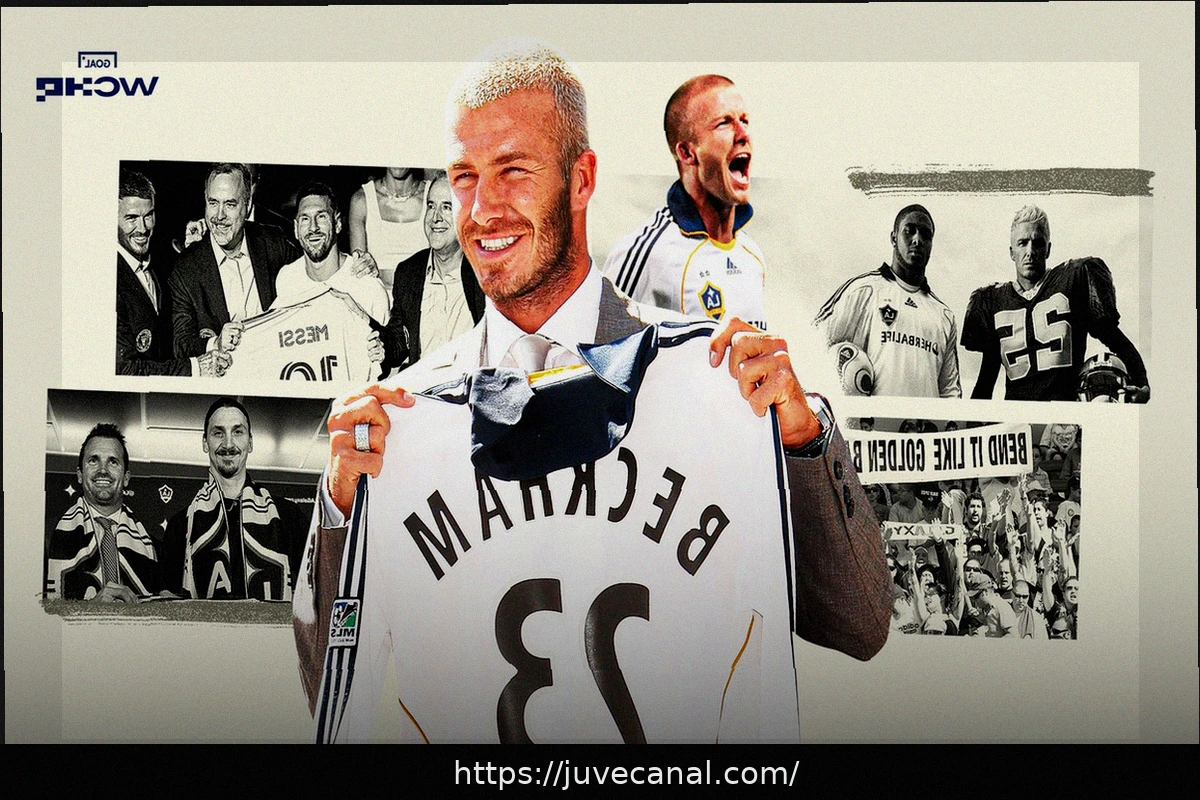
David Beckham’s move to Major League Soccer (MLS) in 2007 was far more than just a player transfer; it was a seismic event that rewrote the league’s future. While many in Europe viewed his arrival in Los Angeles as a precursor to retirement and an embrace of Hollywood glamour, it marked the beginning of something far more profound.
Beckham became the catalyst that propelled MLS onto the global stage, prompting significant rule changes, attracting international superstars, and redefining the league’s identity beyond that of a developing league on the fringes of world football.
Real Madrid President Ramón Calderón famously commented in January 2007 that Beckham was heading «to Hollywood to become half a movie star,» reflecting the uncertainty surrounding the English captain’s future at Madrid. With inconsistent performances and falling out of favor with Fabio Capello, Beckham’s departure from the Spanish club seemed inevitable.
Calderón’s assessment, though cynical, proved to be prescient. Beckham’s signing with the LA Galaxy was a glamorous affair, where he readily embraced the celebrity culture that had long been a part of his footballing life. What critics in Spain had used as a weapon against him, Beckham now wielded with a touch of footballing flair.
The European perspective was largely skeptical, seeing it as a descent into retirement rather than a strategic career move. However, in retrospect, Beckham’s decision appears more like that of a pioneer. He sought something new and different, and his arrival in Los Angeles, with its distinctive flair, was far from coincidental. It was quintessentially Beckham.
For America, this was a stroke of luck. MLS was still in its nascent stages, possessing a semblance of stability but lacking genuine quality. The league was still finding its identity. While Beckham wasn’t the origin point, he was undeniably the catalyst the MLS desperately needed. His presence transformed the league’s perception, compelling the organization to evolve. MLS could no longer afford to think small; it had to aim higher, market itself more effectively, and embark on the arduous journey toward global legitimacy.
The Right Move at the Right Time
This is a story about American soccer and MLS, but it’s also a story about Beckham. Even in his own documentary, some portray his decision to move to America negatively, with Fabio Capello suggesting it would jeopardize his national team prospects.
Context is crucial. At that time, MLS had minimal global recognition, and Beckham’s future at Madrid was uncertain. Yet, what is often overlooked is that Beckham was still an exceptional player capable of joining any club in Europe. While a return to the Premier League was off the table, Italy, France, or Germany remained viable options, and he did eventually play in those leagues.
A pivotal meeting in 2006 changed everything. Tim Leiweke, then co-owner of the LA Galaxy, informed MLS Commissioner Don Garber that Los Angeles was ready to make a significant investment in a European star. Leiweke proposed that Beckham could not only be the star player for the Galaxy but also the face of the league. Despite logistical challenges, Garber was convinced.
The specific club Beckham would join was initially unclear, as MLS founder Phil Anschutz owned three of the league’s 13 teams. Garber, Leiweke, and another league official traveled to Madrid to present their plan: Beckham would become the league’s ambassador, and they would find ways to compensate him handsomely. Los Angeles seemed the natural fit, given Beckham’s celebrity status and his wife Victoria’s even greater fame.
A dinner meeting with Garber, Beckham, and Victoria laid out the vision. Beckham, at 31, was easily persuaded. It was a novel opportunity, unprecedented in its scale. Beckham had always been a trailblazer. The MLS emphasized that his contract and overall commercial value would exceed $250 million. While likely an exaggeration, the message was clear: this was an exciting prospect for someone potentially weary of the European football scene.
Beckham, however, refuted any notion of retirement, stating: «I’m not coming there to be a superstar. I’m coming there to be part of the team, to work hard, and hopefully to win trophies. For me, it’s about football. I’m coming there to make a difference. I’m coming there to play football.»
This was in January 2007, and the deal was finalized. Beckham would leave Madrid after his contract expired.
The “Beckham Rule” and Life in Los Angeles
However, several obstacles could have derailed his commitment.
The primary hurdle was financial. The MLS simply could not afford him. When Garber first pitched the league’s project to Beckham, the MLS salary cap—the total amount available for assembling a full squad—was approximately $2 million. Beckham was reportedly earning five times that annually at Real Madrid alone. Something had to change.
Consequently, the MLS implemented a measure that would outlast Beckham’s playing career: the «Designated Player» rule, quickly dubbed the «Beckham Rule.» This allowed teams to sign players outside their standard salary cap. The intricacies were complex, but it enabled the Galaxy to offer the English captain a substantial salary of $6.5 million per year.
Other clubs followed suit. Chicago Fire, New York Red Bulls, and FC Dallas invested heavily in the rule’s inaugural year, with D.C. United and Sporting Kansas City soon to follow. Claudio Reyna joined the Red Bulls, Cuauhtémoc Blanco signed with the Fire, and Denílson inked a deal with FC Dallas. For the first time, MLS could attract stars on a significant scale.
Beckham’s arrival was met with near-frenzy. His initial media appearances alone lasted nearly four hours.
LA Galaxy’s then-General Manager, Alexi Lalas, asserted that Beckham’s presence would illuminate the league itself. «One of the interesting things that I think people will see, first and foremost, is the attention that he’s going to bring to the sport and to American soccer. People will see the quality that’s here, and I’m absolutely aware that a lot of people in England have no idea what’s going on in Major League Soccer on or off the field,» Lalas stated. «But the fact is, we have competitive teams, competitive individuals, and a very good and growing league. It’s not as if we can’t improve, and I would put our teams up against some Premier League teams any day of the week.»
Then came the celebrity factor—something the Galaxy, as Lalas later admitted, were not fully prepared for. Beckham’s wife, while perhaps not quite as famous, operated in the same stratosphere. As the Beckham documentary later highlighted, they were comfortable among the world’s elite. Within weeks, parties with Tom Cruise and Will Smith were commonplace, with Beckham, impeccably dressed and ready for the paparazzi, in attendance.
It required an adjustment, however. Teammate Chris Klein later confessed the surreal experience of transitioning from anonymity to the Hollywood spotlight almost overnight. «He was a gentleman and very gracious, someone who wanted to be part of the team. But within the first few weeks, we were invited to parties hosted by Tom Cruise and Will Smith. It was all just a little bit overwhelming,» Klein recalled.
More Than Just Success in the USA for David Beckham
Dax McCarty vividly remembers a hot summer day in 2008 when his FC Dallas team faced the LA Galaxy. His teammate, Adrian Serioux, had a specific target: Beckham. Early in the first half, the Canadian launched into a studs-up tackle long after the ball was gone, sending Beckham crashing to the ground. Beckham immediately sprang to his feet, confronting Serioux.
«He got Beckham with a tackle that he probably won’t forget anytime soon. It was borderline assault, and he got sent off,» McCarty recounted to GOAL. «He jumped straight back up and got in the guy’s face… You saw in that moment that it mattered to him.»
This moment perfectly encapsulated Beckham’s rhetoric. For months, he had insisted he wasn’t in MLS for a vacation. Beckham loved football and was determined to prove he could still perform at a high level. His ambitions extended even further.
On the field, however, the results were mixed. His statistics were not stellar. Across five seasons—interspersed with successful loan spells at AC Milan and injuries—Beckham played 117 games, scoring 20 goals. He made the MLS Best XI only once, was never nominated for MVP, and never won LA Galaxy’s Player of the Year award.
There was also tension in the locker room. Beckham assumed the captain’s armband from USMNT icon Landon Donovan upon his arrival—a decision Donovan admitted almost two decades later he «should never have made.»
Nevertheless, there were tangible achievements. Beckham won two MLS Cups and two Supporters’ Shields, helping transform a struggling Galaxy side into a title contender.
His most significant impact, however, was off the field. The Galaxy saw a surge in season ticket sales, secured major sponsorship deals, and witnessed a boom in the business of the ownership group. Across the league, average attendance rose from around 15,500 in the year before Beckham’s arrival to 18,800 by the time he departed.
Perception is harder to quantify. But at the very least, Beckham’s presence helped convince the broader football world that meaningful football was being played outside of Europe and South America. Stars had arrived before—Pelé and Franz Beckenbauer famously played for the New York Cosmos in the old NASL—but few world-renowned names followed. Nearly every significant personality who later joined MLS did so in a league that Beckham had helped shape. Thierry Henry stands out as a prime example.
«It’s good for the game, it’s good for the sport in this country,» Beckham said in 2011. «Myself, Thierry, and him [referring to a potential matchup] have gone up against each other before, because we’ve done it at Manchester United and Arsenal… so people are going to talk about it. That brings a lot of attention to football in this country in different countries.»
Miami, Messi, and What Came After
There was one final piece of the puzzle. As part of Beckham’s original Galaxy contract, he secured the right to purchase an expansion franchise at a preferential rate. MLS was still in its growth phase. When Beckham arrived, there were 13 teams, and the league was still recovering from the loss of two clubs in the early 2000s. During his playing career, six more teams were added. From the outset, it was widely assumed Beckham would eventually own a club.
The terms were straightforward. It would «only» cost him $25 million, and any market was available—except New York City.
Miami emerged as the most logical location. The city had deep footballing roots, and a previous club—the Miami Fusion—had already tested the waters before folding. In 2014, Beckham exercised his option, declaring his intention to bring a team to South Florida. Even then, it was a bargain, especially considering the LAFC paid $110 million for their expansion spot around the same time.
Beckham’s ambitions were never modest. Yes, he wanted the club—later named Inter Miami—to be competitive. But there was also a sense that it would reflect his own celebrity-driven vision of the sport. This was football as entertainment, built around the sport’s biggest names.
Which brings us to the summer of 2023. Lionel Messi had grown tired of life in Paris. He had never truly wanted to be a PSG player after his departure from Barcelona was forced by the club’s financial collapse. A move to MLS had been rumored for some time. In early August, it became a reality.
If Beckham’s arrival in 2007 was transformative, Messi’s was groundbreaking. Miami paid him handsomely and reportedly guaranteed him a stake in the club post-playing career. In a fitting twist, Beckham did for Messi what MLS had once done for him—he secured him a business future beyond his active playing days.
So, Beckham’s legacy ultimately endures. He was the first. He changed the rules. And nearly two decades later, the world’s greatest player followed a path he helped forge.
When Beckham first arrived, Don Garber described the move in glowing terms: «David Beckham is a global sports icon who will transcend the sport of soccer in America and beyond. His decision to continue his illustrious career in Major League Soccer is a testament to America’s rapid ascent as a true soccer nation, with MLS at its heart.»
Nearly 20 years later, Garber might well have been right.