

Paris Saint-Germain triumphed over Arsenal in a penalty shootout to retain their Champions League title. Here are three key observations from the tense final in Budapest.
Kai Havertz put Arsenal ahead in the 6th minute, and Ousmane Dembele equalized with a penalty in the 65th. After a goalless extra time, PSG won 4-3 on penalties. Eberechi Eze and Gabriel missed for Arsenal, while only the visibly exhausted Nuno Mendes failed for PSG.
Arsenal’s Defense Crumbles Against PSG at the Predictable Spot
Everything seemed to be going perfectly for Arsenal. Following Kai Havertz’s early lead, the Londoners could focus on their specialty: defending. Paris Saint-Germain circulated the ball around the opposition box but couldn’t penetrate Arsenal’s compact 4-4-2 defensive system. The Gunners consistently cleared any crosses, tackles, or headers from their penalty area. Scattered long-range shots sailed over the bar.
For 62 minutes, Europe’s best defense had Europe’s best attack under control. Arsenal achieved the seemingly impossible, completely neutralizing PSG’s formidable front three: Desire Doue, Ousmane Dembele, and Khvicha Kvaratskhelia. In Munich, they must have been wondering: How is this possible? PSG had scored a remarkable six goals in their spectacular semi-final against Bayern Munich.
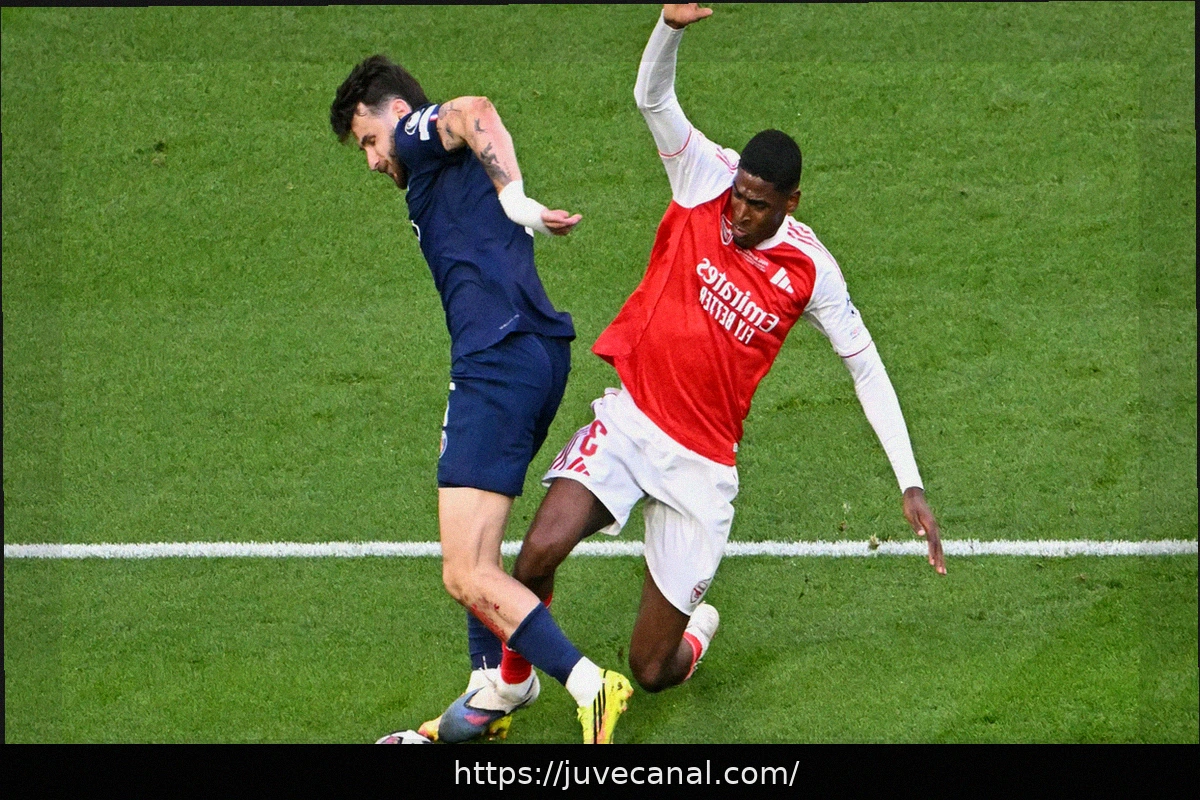
Ultimately, Arsenal’s defensive stronghold against PSG broke at the expected weak point – Arsenal’s problematic right-back position. A starting appearance for the nominal right-back Jurrien Timber, after over two months out, was deemed too soon. His replacement, Ben White, was injured, forcing manager Mikel Arteta to resort to his third choice: the nominal center-back Cristhian Mosquera. The 21-year-old Spaniard was making only his sixth competitive start at right-back this season.
Mosquera found himself up against Khvicha Kvaratskhelia, PSG’s standout player in this Champions League campaign. In the first half, Kvaratskhelia made little headway against Mosquera. Shortly after the break, Mosquera received a yellow card for time-wasting, further complicating his already challenging task. In the 63rd minute, it happened: Kvaratskhelia escaped Mosquera, who tripped him from behind in the penalty area. Ousmane Dembele calmly converted the justified penalty to make it 1-1.
Shortly after, Mosquera was substituted, and Timber celebrated his return on the grandest stage. PSG became slightly more dangerous after the equalizer but rarely created clear-cut chances. Kvaratskhelia missed the best opportunity to take the lead in the 77th minute before also being substituted.
Arsenal’s Most Dangerous Weapon Fails to Fire Against PSG
Very late in extra time, a sudden roar of jubilation erupted in the Puskas Arena. Arsenal fans raised their fists, accompanied by chants. Why? The Londoners hadn’t scored the decisive 2-1 goal, but they had been awarded a corner. Arsenal’s fans knew: victory was now within reach (ha, sorry).
After all, the Londoners are the undisputed corner-kick kings of Europe – partly due to their innovative methods of unsettling opposing goalkeepers near the limits of legality. They scored 18 goals en route to their league title, a Premier League record. Corners had also proven to be a decisive weapon in Arsenal’s victory against FC Bayern in the autumn. And now? Noni Madueke’s delivery was cleared, and the winning goal didn’t materialize even after a subsequent scramble in the box. Then, referee Daniel Siebert blew the whistle.
This time, at least, it was after the corner was taken. Shortly before the end of the first half, the Londoners had also been awarded a corner – their first of the game. While Arsenal fans were anticipating a goal celebration, Bukayo Saka sauntered leisurely towards the corner flag. However, for German referee Daniel Siebert, it was a bit too leisurely. As injury time had already expired, he promptly blew for halftime. Arsenal’s players reacted with disbelief. The next opportunity didn’t arise until the start of extra time, when Madueke had two attempts. He was denied by Goncalo Ramos on the first, and the second went wide of the post. Thus, Arsenal’s most potent attacking weapon was rendered ineffective against PSG.
The Two Germans Impress in Budapest
Although no Bundesliga team was represented in the Budapest final, two Germans were on the pitch. Firstly, referee Daniel Siebert, who, despite the Londoners’ outrage, delivered an overall impeccable performance. Siebert’s crucial decisions were correct – and he wasn’t afraid to make difficult calls.
His decision to disallow Arsenal’s corner in first-half stoppage time was as justifiable as awarding the penalty to PSG and issuing Mosquera’s earlier yellow card for time-wasting. Siebert also correctly disallowed a wrong throw-in by Joao Neves. While debatable, it wasn’t incorrect for him not to award Arsenal a penalty for an alleged foul on Madueke in extra time; Madueke had initiated contact during a run and seemed to be forcing the call. Because Arteta and Declan Rice complained too energetically, Siebert booked both. After such a commanding performance in European club football’s biggest match, it seems even more surprising that FIFA did not nominate Siebert for the World Cup.
Alongside Siebert, the second German in Budapest also impressed: Havertz gave Arsenal an early 1-0 lead, underscoring his status as a player for the big moments. In 2021, the 26-year-old from Aachen scored the winner for his former club FC Chelsea in the final against Manchester City. On the penultimate matchday of this Premier League season, he paved the way for Arsenal’s title with his goal to make it 1-0 against FC Burnley.
Even though his goal in Budapest ultimately went unrewarded, Havertz at least became only the third player to score in a Champions League final for two different clubs (since the introduction of the new format in 1992). The other two were Cristiano Ronaldo (Manchester United, Real Madrid) and Mario Mandzukic (Juventus Turin, Bayern Munich).