

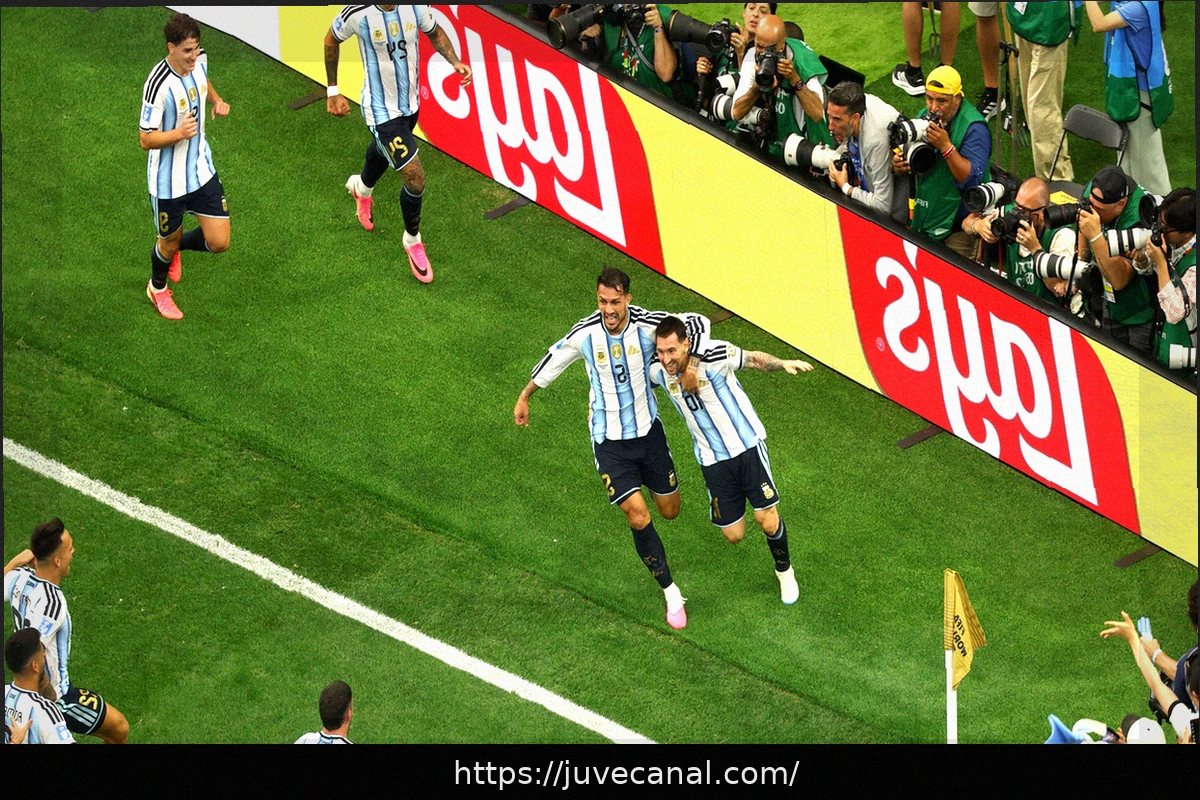
Lionel Messi, in a record-breaking performance, presents himself as a version of himself at least 12 years younger. The VAR caused controversy twice, and Austria’s players could benefit from a bit more audacious belief. Here are three key takeaways from Argentina’s 2-0 victory over Austria.
Lionel Messi Breaks More Than Just the Goal Record
It likely came as no surprise to many that Lionel Messi became the sole record goalscorer after only the second match of the 2026 World Cup. Following his hat-trick against Algeria in the opener, which arguably shouldn’t have happened after a red-card worthy foul by Messi in the first half, he needed just one more goal to surpass Miroslav Klose.
More surprising, yet still not a complete shock, was Messi’s miss from the penalty spot on his first chance to score his 17th World Cup goal. This was Messi’s 33rd missed penalty in his long career, and this penalty, in particular, arguably should not have been awarded (see the next point). Messi then secured the record in the 38th minute with his signature move, borrowed from Helmut Rahn: a short sprint from midfield into space, a sharp cross from a teammate, and a powerful, almost always unstoppable curling shot.
Neither the goal itself nor the manner of its scoring was surprising in this record-breaking show by Lionel Messi. However, Messi’s overall performance against Austria did bring joyful amazement. Just as against Algeria, Messi almost single-handedly willed his Argentinians to victory. While the first goal was a typical Messi goal, the beautiful second goal in stoppage time paired resilience with genius. Messi initiated the move himself and didn’t give up even after Alex Schlager had thwarted the opportunity twice.
Two days before his 39th birthday, Messi not only seemed determined to break the goal record but also to definitively show the world who the one true GOAT is.
Messi not only scored two wonderful goals, but he also secured victory for his Argentinians for the second time. Messi was an absolute force, suddenly appearing like a version of himself at least twelve years younger. He touched the ball at least once in almost every area of the field. No player on the pitch moved with the ball at their feet as much as Messi; only central defenders Kevin Danso and Lisandro Martinez achieved similar statistics.
While in past years Messi often masked his extended periods of inactivity in games with one or two moments of brilliance, against Austria, he strung together one valuable action after another, compensating for his teammates’ weaker phases.
VAR Causes Two Controversies
Aside from the fact that the initial decision by Egyptian referee Mohamed Omar not to award a penalty for a double tackle by Simon Posch and Xaver Schlager on Lautaro Martinez in the Austrian penalty area was perhaps a little too lenient towards Austria, it wasn’t a clear incorrect decision. Both Posch and Schlager made contact with the ball, and their feet were close to the turf.
The VAR’s involvement in this situation was therefore rather unnecessary. What is completely incomprehensible is the discussion between the VAR and Omar for more than three minutes before Omar finally reviewed the scene and, consequently, awarded a penalty.
Almost more incomprehensible: Why did the VAR not intervene in the 38th minute when Xaver Schlager was fouled by Alexis MacAllister in midfield? Admittedly, the incident didn’t necessarily warrant a whistle. However, without that foul, Argentina likely wouldn’t have been in a position to allow Lionel Messi to score his most typical goal. Omar’s decision not to blow the whistle was consistent with his approach of letting play flow, but if the VAR intervened for the penalty, it could have done so here as well.
As is often the case with VAR (when it’s not about handball, where the rules are simply nonsensical): the problem is often not the rules themselves, but the referees’ implementation. Unfortunately, the World Cup is no different from national leagues or cup competitions in this regard.
Austria’s Players Could Benefit from Their Fans’ Sympathetic Delusions of Grandeur
In recent days, an unusually sensible and wonderfully innocent AI-generated video titled «Weltmeister OIDA!» went viral. It depicts David Alaba, Ralf Rangnick, and Marcel Sabitzer 30 years in the future, reminiscing about July 19, 2026, when, in the final against Germany, Konrad Laimer «ran towards the German goal with his last strength and a lot of courage» – and then…
«There are children who weren’t even born in 2026, and yet, they know exactly where they were back then,» says Austria’s President at the end. A sentence for eternity, which could only come from a former footballer, and of course, Austria’s President in 30 years is a world champion, Marko Arnautovic.
But viral AI videos aside: Of course, Austria will not beat Germany on July 19 in the World Cup final, and not because Austria will advance further than the DFB team in this World Cup. However, the healthy belief in winning, with which the Austrians are celebrating their first World Cup participation in 28 years, is not entirely over the top.
Austria, which struggled somewhat in their opening 3-1 win against Jordan, played on par with the world champions for long stretches against Argentina – and at times even had a slight edge. Marcel Sabitzer delivered a captain’s performance in his 100th international match, as did David Alaba. Goalkeeper Alex Schlager saved almost everything he could, and Romano Schmid from Bremen was a real force, just as he was against Jordan.
Austria primarily lacked the final decisive edge in build-up play and attack. The players repeatedly retreated during pressing instead of attacking fully. At times, they themselves seemed to doubt that they truly had a chance to win against Messi and Co. The team would benefit from a bit of the ambitious belief that is currently rampant among fans in the Alpine republic.
And yet: With another performance like the one against Argentina in their final group game against Algeria, and at least one goal, Austria could advance to the round of 16 as group runners-up. Spain could then be their opponent, and at the latest then, Alaba, Arnautovic, Laimer, and Co. would have to present themselves like world champions if they want to progress further.