
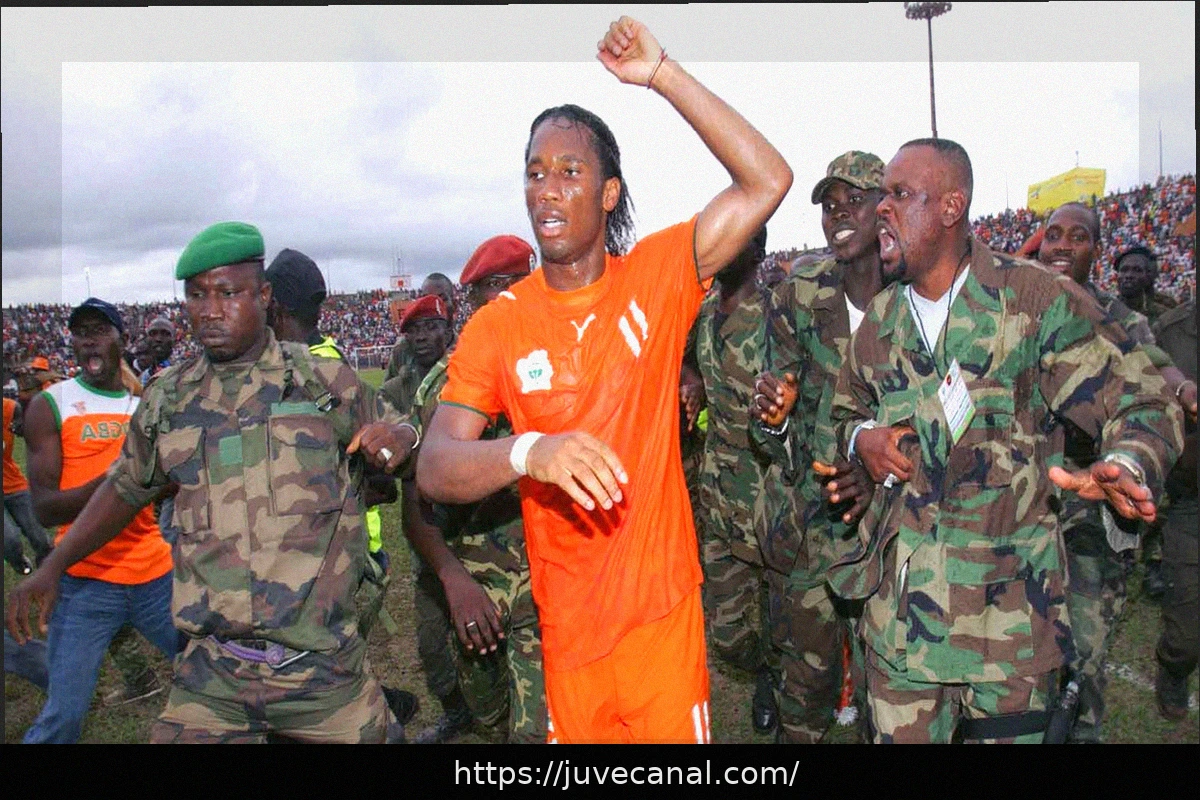
On the field, Didier Drogba was a warrior; off it, a peacemaker. The long-time FC Chelsea goalscorer played a crucial role in the peace process in Ivory Coast. This is part 12 of our series, Rebel United.
«Ivorians, from the north and the south, from the center and the west,» Didier Drogba began. He spoke not like a footballer, but like a president. «Today we have proven that all inhabitants of Ivory Coast can live together and fight for a common goal: World Cup qualification.»
Thanks to a 3-1 victory in Sudan and Cameroon’s simultaneous slip-up, Ivory Coast qualified for their first World Cup on October 8, 2005. But Drogba wasn’t finished; he wanted peace to follow World Cup qualification. For three years, civil war had raged in Ivory Coast. In the west lay the army-controlled, predominantly Christian, wealthier south. In the east were the rebels in the more predominantly Muslim north.
«Today, we beg you on our knees,» Drogba said, dropping to his knees, followed by all his teammates. He then declared: «Forgive each other! Forgive each other! Forgive each other! Do not let our rich country be devastated by war. I implore you: lay down your arms. Organize elections, and everything will be better.» Drogba and his teammates then began to sing and dance.
The then 27-year-old FC Chelsea striker was more famous and beloved than anyone else in his country. He was arguably the only person whom all Ivorians revered – and to whom everyone listened. Shortly after his plea, the warring factions agreed to a ceasefire. However, it was fragile, and elections did not immediately follow.
Didier Drogba Plays with the National Team in the Rebel Stronghold
In the subsequent summer’s World Cup in Germany, the highly fancied Ivorians were eliminated early from the so-called «group of death» alongside Argentina, the Netherlands, and Serbia and Montenegro. At the Africa Cup of Nations the same year, they reached the final but dramatically lost on penalties to Egypt. Despite these setbacks, Drogba was awarded the African Footballer of the Year award for 2006 on March 1, 2007, also due to his successes with Chelsea. Just three days later, the government and rebels agreed to another ceasefire.
At the end of March, President Laurent Gbagbo invited Drogba to his palace. The goalscorer, belonging to the Bete ethnic group like Gbagbo, proudly showed off his trophy and informed the president of his intention to present it in the rebel stronghold of Bouake: «This is the ball that belongs to our entire country!» The following day, Drogba traveled to Bouake and met rebel leader Guillaume Soro. He not only brought the trophy but also the promise of hosting a national team match in Bouake.
In June 2007, Ivory Coast indeed played in the rebel stronghold, defeating Madagascar 5-0 in an Africa Cup of Nations qualifier. Two months later, Gbagbo followed Drogba’s footsteps. The Ivorian President traveled to Bouake, not for a football match, but to jointly burn weapons with rebel leader Soro in the same stadium, officially declaring the civil war over.
‘On the Field, I Am Different’: The Two Sides of Didier Drogba
Drogba was born in Abidjan, southern Ivory Coast, in 1978. At the tender age of five, his parents sent him to France to live with his uncle, Michel Goba. Goba moved from one second-division club to another as a professional footballer, and Drogba was often allowed to play in youth teams. Drogba briefly returned to his homeland at age eight. At eleven, he traveled back to his uncle in France. This time, Drogba came to stay.
He was a late bloomer in football. At 21, he debuted for FC Le Mans in Ligue 2, and at 23, for EA Guingamp in Ligue 1. After a year at Olympique Marseille, Drogba transferred to FC Chelsea in London in 2004 at the age of 26. This was to become *his* club. The equally elegant and powerful goalscorer won the Premier League four times with Chelsea and, in a crowning achievement, the Champions League in 2012. In the final against Bayern Munich, Londoners were thoroughly outplayed. However, Drogba rescued his team with a late header to force extra time and ultimately scored the decisive penalty in the shootout.
Shaped by Jose Mourinho, Chelsea cultivated the role of the villain in world football. Few personified it as well as Drogba. «If I had to choose one player to go into battle with, I would take Didier,» Mourinho once said. Drogba was sent off seven times during his career. This included the 2008 Champions League final loss to Manchester United for an elbow to Nemanja Vidic. In the 2009 semi-final exit against FC Barcelona, Drogba aggressively confronted referee Tom Henning Övrebö to such an extent that he received a three-match ban, and Övrebö received death threats. «On the field, I am different, and sometimes I don’t recognize myself,» Drogba said. On the pitch, the ruffian; off the pitch, the peacemaker.
Didier Drogba Engages in the ‘Truth and Reconciliation Commission’
The Ivorian ceasefire of 2007 held until the 2010 presidential election. Alassane Ouattara from the north won against incumbent Gbagbo, who refused to concede defeat. The civil war reignited, and Drogba, who had recently been included in *Time* magazine’s list of the 100 most influential people in the world, again spoke out forcefully: «I call on each and every one of you, every person in authority, and every party supporter to reject all violence and do everything possible to restore a calm and responsible democracy.»
A few months later, Gbagbo was arrested, and Ouattara, who still governs today, was sworn in as president. Meanwhile, an eleven-member ‘Truth and Reconciliation Commission’ was established to investigate the events surrounding the election and secure peace, which also included Drogba. Independently, he continued to support charitable causes through his own foundation, repeatedly donating substantial sums. Drogba concluded his football career in China, Turkey, and the USA. The Ivory Coast’s record goalscorer retired in 2018.
When asked why he never entered politics, Drogba replied, «Today, everyone listens to me when I speak. As soon as I choose a particular party, it’s 50 percent at best.» It is precisely because he never became a politician that Drogba is so valuable to Ivory Coast. Or, as his long-time national teammate Geoffroy Serey Die once said, «Didier Drogba is more important to our country than the President.»
Didier Drogba: His Professional Football Career Stations
| Period | Club | Games | Goals |
|---|---|---|---|
| 1998 to 2002 | FC Le Mans | 71 | 15 |
| 2002 to 2003 | EA Guingamp | 50 | 24 |
| 2003 to 2004 | Olympique Marseille | 55 | 32 |
| 2004 to 2012 | FC Chelsea | 341 | 157 |
| 2012 to 2013 | SH Shenhua | 11 | 8 |
| 2013 to 2014 | Galatasaray Istanbul | 53 | 20 |
| 2014 to 2015 | FC Chelsea | 40 | 7 |
| 2015 to 2017 | CF Montreal | 41 | 23 |
| 2017 to 2018 | Phoenix Rising FC | 26 | 16 |