

Alexander Zverev has finally achieved his Grand Slam dream, emerging victorious after what was arguably the most challenging two weeks of his career. This historic win is far from a «gift» and signifies a new chapter, not the end, of his journey.
After four hours and 16 minutes of intense play, Alexander Zverev collapsed in tears onto the red clay of Roland Garros. The player who had so often fallen just short of his ultimate goal had finally triumphed, claiming his first Grand Slam title in an epic final against the underdog Flavio Cobolli. In doing so, Zverev etched his name into German tennis history, becoming the first German player to win at Roland Garros in the Open Era since 1968. The last German victory in Paris was by Henner Henkel in 1937, when the tournament was still known as the ‘French Championships’.
Despite this monumental achievement, some critics have suggested that the victory was tainted. With Carlos Alcaraz absent due to injury, tour dominator Jannik Sinner and legendary Novak Djokovic exiting the tournament unexpectedly, and Zverev seemingly having a clear path to the title, questions have arisen: Was Zverev’s journey to the Parisian throne too easy? SPOX argues against this in three parts.
Alexander Zverev Follows in Ivan Lendl’s Footsteps: Conquering His Demons!
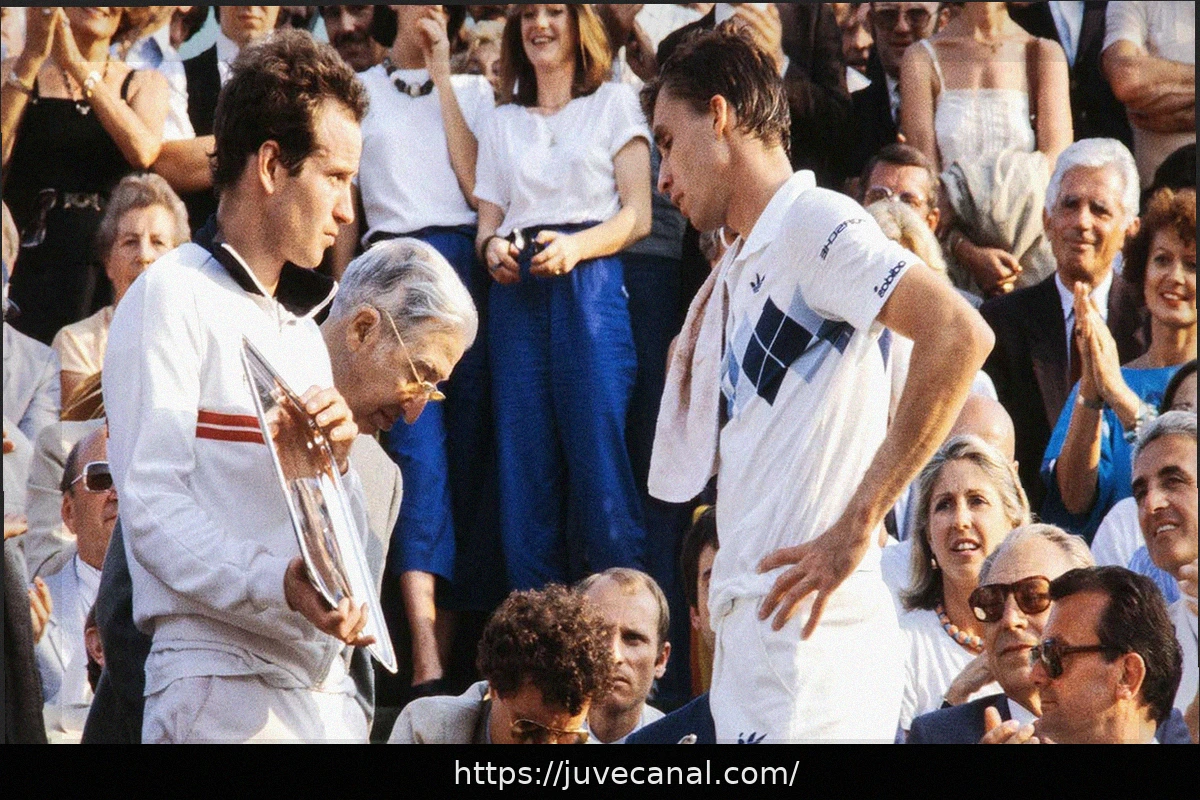
Zverev’s victory inevitably brings Ivan Lendl to mind, especially in the context of Paris. This connection stems not just from personal age and experience, but also from historical parallels. Lendl, before becoming one of the all-time greats, had to overcome formidable opponents. The 1984 French Open final, an early and vivid sporting memory, saw Lendl face the dominant John McEnroe, whom he had lost to in five previous finals. McEnroe was not only a superior player at the time but also a difficult personality. On June 10, 1984, McEnroe was on an incredible 43-match winning streak for the year and seemed poised for victory, leading Lendl two sets to love (6:2, 6:3).
However, the match dramatically shifted. Slowly but surely, Lendl fought back, point by point, building confidence and eventually dominating a still-excellent McEnroe, even winning the mental battle without a «meltdown.» Lendl took the remaining sets 6:4, 6:4, 7:5, securing his first Major title – a feat Zverev has now replicated 42 years later on the same court.
Lendl had already achieved numerous victories, with Paris ’84 being his 41st tour title. Yet, the absence of a Grand Slam title weighed heavily on him. His ability to turn that match around, despite past failures, was particularly impressive. He had lost in four previous Grand Slam finals, a record that seemed at odds with his overall success.
Similarly, Zverev, with 24 titles including seven Masters 1000 events, two ATP Finals, and an Olympic gold medal, had also faced the stigma of being an incomplete player due to his lack of a Grand Slam title, despite three previous final appearances. Even now, some will argue that his victory is diminished because Alcaraz and Sinner were not in his path.
What lies ahead? Lendl was 24 when he conquered his demons; Zverev is 29. But isn’t 30 the new 22 in today’s tennis? Lendl went on to win seven more Major titles. The challenge is now for «Sascha» to do the same.
A Masterclass in Development: Alexander Zverev Silences Critics in the French Open Final
The «what» is clear: Alexander Zverev is a Grand Slam champion and the first German to triumph at Roland Garros in the Open Era. This is a magnificent and fitting achievement. However, the «how» should not be overlooked when recalling this final. It should also silence the critics who claim Zverev was handed this victory due to Carlos Alcaraz’s injury and the early exits of Novak Djokovic and Jannik Sinner. A gifted Grand Slam? Far from it!
Firstly, this view is disrespectful to both Zverev and his final opponent, Flavio Cobolli. Zverev has proven throughout the tournament that he deserves to be considered one of the world’s best players, dropping only two sets before the final – a dominant performance. Furthermore, the 24-year-old Cobolli played an outstanding final, apart from the first set, causing the German favorite significant problems and pushing him to his absolute limit.
This mirrors Dominic Thiem’s performance in the 2020 US Open final. At that time, Zverev crumbled just two points away from his dream, burdened by the pressure of carrying German men’s tennis after Boris Becker. Years of doubt followed, particularly concerning Zverev’s mental fortitude in crucial moments, despite his ATP Finals and Olympic gold medals.
In the 2022 French Open, after defeating Alcaraz in the quarterfinals, it seemed Zverev had finally put everything together. However, a devastating ankle injury in the semi-final against Rafael Nadal dashed his hopes. He had engaged the «King of Paris» in a thrilling match for two sets, and despite being a set down, it felt like Zverev might dethrone Nadal on his home turf and finally win that elusive Grand Slam.
But fate intervened. Zverev underwent a long rehabilitation. Meanwhile, Alcaraz and Jannik Sinner rose to prominence, ushering in a new era. The window for a Grand Slam title seemed to be closing, especially after Sinner dominated him in the 2025 Australian Open final. Whispers grew louder that Zverev needed to make changes, particularly in his coaching setup, which had always been handled by his father and brother Mischa, to achieve his Grand Slam dream. As the ultimate prize remained elusive and his prime years seemed to be slipping away, pressure and criticism mounted.
All of this culminated in the past two weeks in Paris and a dramatic final. Over these two weeks, Zverev proved his doubters wrong. By the time Sinner and Djokovic were out, he was the marked man at Roland Garros. Yet, Zverev defied this pressure, sweeping through his opponents at times en route to the final, playing exceptional clay-court tennis, and making only a couple of significant errors.
Against Cobolli, he passed his final career maturity test. Admittedly, it wasn’t his best performance in four out of five sets. There were moments of visible nerves, and physical issues clearly hampered him from the latter stages of the fourth set.
Despite this golden opportunity, everything seemed to be working against Zverev once again. When Cobolli forced a tie-break in the fourth set, the memory of the epic final against Thiem six years prior loomed large. However, Zverev defied all expectations. He has matured. He demonstrated that a great tennis player, with his back against the wall, can cleverly manage his remaining strength and utilize past bitter final experiences to his advantage.
This Grand Slam victory is by no means a «gift.» It is the result of hard, relentless work, and the culmination of numerous dramatic and sometimes self-inflicted setbacks.
In that spirit, «Sascha» deserves the greatest respect, and his own words echo the sentiment: «We have been through so much together. We’ve had injuries and heartbreak. We’ve been losers sometimes, especially in the big moments. But in the end, we are Grand Slam champions. That’s what matters.»
Withstanding the Pressure: Alexander Zverev’s Triumph Deserves Even More Respect
One can already anticipate the voices that will downplay the significance of Zverev’s first Major title following his French Open triumph. In some circles, the argument will be: «Against these opponents, it was not a real challenge. A player of his caliber was expected to beat them all.»
Indeed, based purely on statistics, the 29-year-old did not defeat a single Top-10 player in his seven matches leading up to the Grand Slam. His final opponent, Cobolli, was ranked 14th before the tournament and only moved into the Top 10 due to his points accumulated in Paris.
However, it is precisely this circumstance that, in my opinion, elevates the importance of this title. Especially after Djokovic’s epic third-round exit to Joao Fonseca, and more significantly, after Sinner’s heat-induced collapse in the previous round, Zverev became the undisputed favorite to win.
For the first time in his career, he had to carry the pressure of being the de facto «Designated Champion» in every match. Given his history of three lost Grand Slam finals and the reputation of being perhaps the best male tennis player without a Major title, this was by no means an easy task. After all, even under these circumstances, there were undoubtedly still many who questioned his mental resilience under such intense scrutiny and anticipated his failure.
The fact that Alcaraz, the reigning champion at Roland Garros, could not compete, that the seemingly invincible Sinner succumbed to external factors and the immense physical toll of recent weeks on Court Philippe-Chatrier, and that record champion Djokovic let a 2-0 set lead slip against the young Brazilian Fonseca – these are all events that were not Zverev’s doing.
He did what he had to do. He defeated the seven players who, through various paths, eliminated his perceived threats. One can hardly ask for more. And for that, he deserves the utmost respect.