

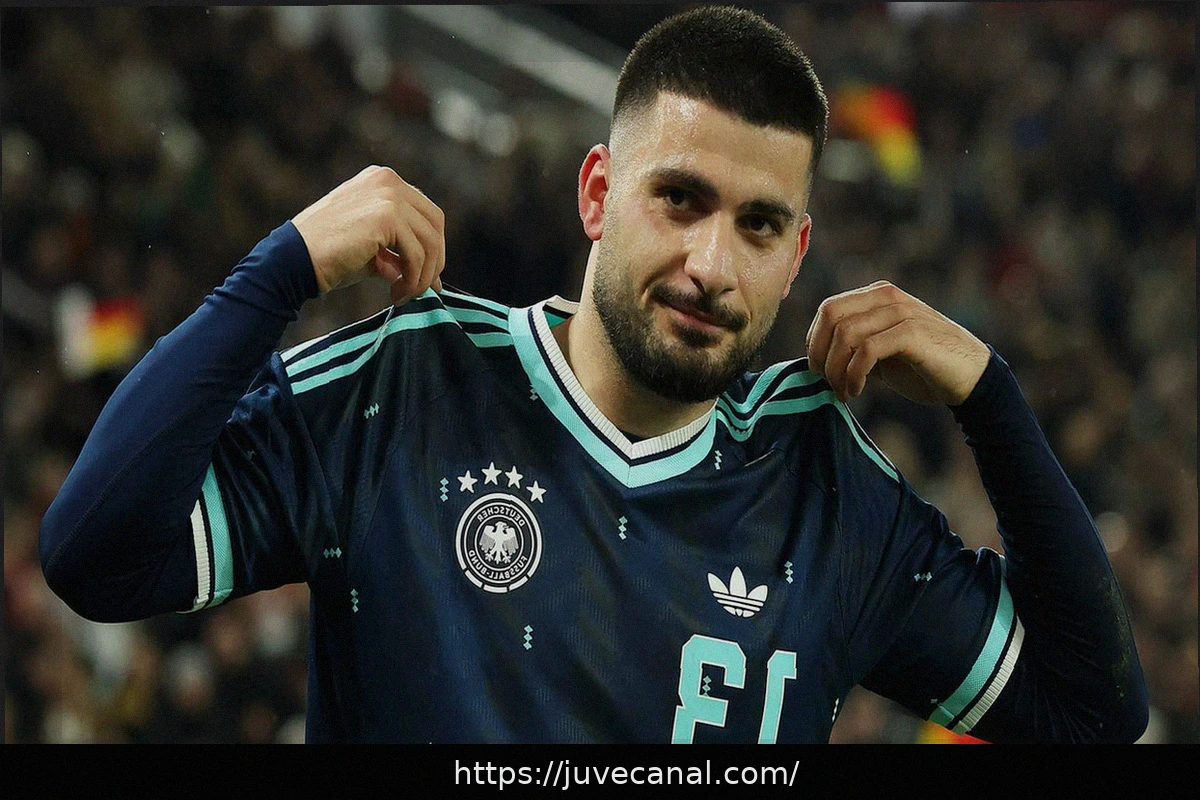
The German national team’s offense, with or without Deniz Undav, showed promise, while Lennart Karl made a strong case for a permanent spot. Despite some defensive wobbles, Julian Nagelsmann’s strategies appear to be taking hold. This assessment identifies the winners and losers within the DFB squad following the recent March training camp.
Germany kicked off its World Cup year with two deserved victories. While the DFB team lacked consistent dominance in periods during their 4-3 win against Switzerland and 2-1 victory over Ghana, the fundamental structure and strategy for the upcoming World Cup, just 72 days away, are in place.
Consequently, there’s little reason to significantly alter the current squad, a point Julian Nagelsmann emphasized during his squad announcement and in a much-discussed interview. However, adjustments are still necessary in certain areas, which could potentially impact some players. Not everyone impressed, while others seized their opportunities – or even benefited as mere spectators.
Ultimately, winners and losers emerged across all positions. The attacking unit, particularly returning players Kai Havertz and Florian Wirtz, excelled in their interplay. Both exuded joy in their play, showcasing impressive dribbling and vision. Wirtz arguably delivered his best performance for the national team against Switzerland, being directly involved in all four goals, scoring two himself with his exceptional shooting technique. Notably, Nagelsmann deployed him nominally as a left winger, with Serge Gnabry operating in the number ten role. Bayern’s versatile attacker repeatedly made short runs into the box, creating space for Wirtz to express his creativity – the second goal against Switzerland exemplified this idea. Against Ghana, however, Gnabry appeared less effective.
Havertz, meanwhile, exhibited a familiar issue: a recurring lack of clinical finishing in front of goal. Despite numerous clear chances, he managed only one goal from a penalty. At the European Championship, as an undisputed starter, he also scored exclusively from the spot (twice). Nevertheless, Havertz retains Nagelsmann’s full confidence and is considered a certainty. The only question is his specific role. If Jamal Musiala, recently injured, regains fitness in time, he might lead the attack or occupy the right wing as he did against Ghana. In that scenario, the competition for a spot would likely come down to Gnabry and Nick Woltemade.
Deniz Undav: A Mixed Bag for «Everybody’s Darling»
Despite his ongoing dip in form at struggling Newcastle United, Nick Woltemade remains Nagelsmann’s primary option for a nominal number nine striker. Woltemade, starting against Ghana, impressed as a target man, even if he didn’t score himself. His key advantage lies in offering a different attacking element compared to his competitors. Deniz Undav, however, must settle for a super-sub role.
The Stuttgart striker emerges from the training camp as both a winner and a loser. «Everybody’s Darling» fulfilled his coach’s brief, shining as a «finisher» with his winning goal in front of a home crowd. Nagelsmann justified Undav’s substitute role by explaining that his qualities are best showcased against tired opponents, correctly noting that a significant portion of his 23 goals for VfB (16) were indeed scored in the second half.
At the same time, Undav publicly questioned the «role discussions» Nagelsmann frequently mentions, expressing hopes for more playing time during a post-match interview. Whether this was a wise move is debatable. Nagelsmann, who had previously stressed his desire to only select players who accept their roles without complaint, likely did not appreciate the comment. Although Undav later conceded he would «accept» it, Nagelsmann reacted visibly irritated – and unnecessarily blunt – at the subsequent press conference when asked about the statement: «He puts himself under pressure with his statements. So it’s fine by me, as soon as he starts scoring fewer goals. If he’s okay with that, he can go ahead.»
It’s also true that Undav was barely involved in the game until his goal, a fact not lost on Nagelsmann. «I didn’t think his performance was good until the goal,» he stated, referring to the Stuttgart player’s few ball contacts (13). Yet, he acknowledged, «But that’s why he’s a top striker – that he’s there when the ball falls.» Nagelsmann also questioned if Undav «would finish it like that if he had run for 70 minutes beforehand» and reiterated, «We will need impact players in the summer who can decide a game. That is his assignment, his role.» Is the debate over then? Probably not for now, even though Nagelsmann already seems fed up with it. «We’ve had seven days of ‘the Deniz Undav issue’ now.»
Lennart Karl’s World Cup Bid – Leroy Sane’s Mixed Fortunes
What applies to Undav also partly holds true for Leroy Sane. The nomination of the Galatasaray Istanbul winger had caused considerable bewilderment among experts and fans – which was unsurprising given Nagelsmann’s comments last summer after Sane’s move to Turkey. The clear demand was for more goal contributions than in the Bundesliga, but for several weeks, Sane hasn’t even held a regular starting spot at the Turkish league leaders.
Consequently, many eyes were on his starting performance against Switzerland, where the long-serving Bayern star was quite disappointing. The almost invisible Sane won only one of his many dribbles while magic unfolded around him. Nagelsmann, however, didn’t want to «write him off.» He argued that «we need one-on-one players and don’t have them in abundance, especially inverted wingers,» naming Lennart Karl and Jamie Leweling as direct competitors. «Leroy knows what is demanded – and he has to show it.»
Sane did precisely that against Ghana after coming on as a substitute, cleverly setting up Undav’s 2-1 winning goal. Nagelsmann subsequently credited him with a significant improvement in performance. And Karl? He managed to impress in both matches as a substitute with his irresistible dribbling.
As a result, the teenager received perhaps the highest praise possible from Nagelsmann, which should also serve as a hint to Said El Mala, who was nominated in the previous training camp: «Of all the young players we’ve nominated over time, he made the best impression.» Undav followed up with a comparison to Ribery, raving about Karl’s «coolness at that age.» It seems this was more than just a trial run with the «big boys»; he can probably start packing his World Cup bags.
The Kevin Schade Puzzle: Maximilian Beier as the Beneficiary?
Although Jamie Leweling missed both matches, his exclusion from the World Cup squad would still be a major surprise. The Stuttgart player can operate on both wings and has proven to bring significant impact as a substitute. His recently called-up teammate, Chris Führich, however, didn’t seize his opportunity after being subbed on against Ghana, while Kevin Schade didn’t get one at all.
Nagelsmann had nominated the lightning-fast former Freiburg player from Brentford with the rationale that he should get a taste of the national team environment and integrate with the squad. Instead, Dortmund’s Karim Adeyemi and **Maximilian Beier** were overlooked – and despite Leweling’s absence, they weren’t called up. «I was transparent with all three: as of today, we will take one, maximum two, of these counter-attacking forwards,» Nagelsmann explained. «Kevin now has the advantage of showing himself to us. But the others also had that advantage before.»
Ultimately, Schade was only allowed to showcase his abilities on the training pitch, leaving much room for interpretation. Adeyemi and Beier certainly wouldn’t have been sad about this. Especially the latter could be the major beneficiary, having recently shown top form at **BVB** and repeatedly excelled in a substitute role there. As a tireless worker, Beier is likely the player who can best implement Nagelsmann’s preferred pressing style, both defensively and offensively. Adeyemi, however, currently has arguably the weakest prospects, having lost his starting spot under his club coach around the turn of the year and showing little impact off the bench so far.
Nathaniel Brown Makes a Statement – Should David Raum Be Concerned?
Nathaniel Brown, in contrast, made a strong impression, starting against Ghana. Unlike David Raum, Brown interpreted his left-back role with a much more central focus, building on his excellent form as a disguised holding midfielder/box-to-box player at Eintracht Frankfurt since his club coach’s appointment. Brown provided cover for the active attacking players and maintained complete control of his flank, despite facing arguably the toughest opponent among the weaker African side in Manchester City’s winter signing, Antoine Semenyo. He won several crucial tackles during the guests’ few transitional moments.
Should the usually guaranteed starter, David Raum, therefore be worried about his World Cup starting spot? Offensively, the Leipzig player has been a real weapon this season, but defensively he is occasionally vulnerable. This was evident in the 1-2 loss against Switzerland, where he allowed cross-provider Silvan Widmer too much space before Breel Embolo’s goal. However, he also made a crucial save against Johan Manzambi, which could have made it 3-2. Raum is likely still a starter, but a Brown in this form could become a genuine alternative during the tournament. Interestingly, at the home European Championship, it was Raum himself who fought his way into the starting XI as a Plan B, displacing Maximilian Mittelstädt. For the Stuttgart player, however, the door is now permanently closed after his non-selection.
Angelo Stiller Cannot Compete Against Leon Goretzka and Special Status
The same fate likely awaits Angelo Stiller should Aleksandar Pavlovic and, more importantly, Felix Nmecha regain or maintain fitness in time. Pavlovic has already returned to training, while Nmecha faces a race against time. The recently called-up Stiller started both friendlies and performed adequately overall, but nothing more. He largely confirmed Nagelsmann’s assessment that Pavlovic currently has the edge. Nmecha’s absence seems to be Stiller’s only real chance for a nomination.
Furthermore, Pascal Groß enjoys a sort of special status as a connector and Nagelsmann’s «extended arm» in the team, even though he didn’t particularly impress against Ghana. Thus, it was no surprise that Anton Stach wasn’t given another opportunity to make his case. The Leeds United midfielder had actually made a positive impression with good actions after coming on against Switzerland and even contributed to the 4-3 winning goal. He could also provide the desired counter-pressing support and «dirty work» for Joshua Kimmich, but Nagelsmann clearly has other plans.
This is where Leon Goretzka comes into play. Although he didn’t set the world on fire, he clearly fits Nagelsmann’s desired player profile for the position alongside Pavlovic or Nmecha. As announced beforehand, Goretzka serves as a «line-breaker» in the attacking third. With his physicality, he is intended to occupy opponents as a «free radical» and offer an outlet, which he did effectively in the final phase against Ghana with his pass to assist-provider Sane.
Given that Kimmich operates between the right flank and the center, Goretzka’s presence in midfield during possession-heavy games isn’t missed either. The captain was hardly less involved in the game than at FC Bayern and utilized his qualities on the ball just as well. Defensively, he also did a decent job, even if there was often a lot of space behind him, making him not entirely blameless for Switzerland’s first goal. However, Nagelsmann doesn’t really have a serious alternative for the right-back position anyway, a fact confirmed by stand-in Josha Vagnoman’s weak tackling before Ghana’s equalizer – to his and his teammates’ dismay – after three years of DFB absence. It’s quite possible that Benjamin Henrichs or Ridle Baku (both RB Leipzig) might return to the national team for this reason.
Nico Schlotterbeck and Jonathan Tah Are Set – Antonio Rüdiger as Challenger
In central defense, the situation is also clear. Nico Schlotterbeck and Jonathan Tah will go into the World Cup as the undisputed starting duo, come what may. Schlotterbeck’s two errors against Switzerland will not change this. After all, he is required to play space-opening passes in the build-up.
Of course, Nagelsmann’s confirmation, who had already hinted at a starting spot for Schlotterbeck and gave the **BVB** defensive leader strong backing after the Switzerland match, looks different in practice. A reason for the national coach’s conviction is obvious: Schlotterbeck is the only center-back with a strong left foot in the current squad, which is simply essential in such a ball-oriented system with Nagelsmann’s demands. It remains to be hoped that these were isolated mistakes.
On the other hand, there is no doubt about Schlotterbeck’s individual class in defending space and in duels. Tah also benefits from this, though he occasionally struggles to react quickly in fast transition moments. Against Switzerland, he was also too passive during two goals conceded.
However, Tah currently holds a significant lead over challenger Antonio Rüdiger. Even if the Bayern defender didn’t look his best in one sequence against Ghana and could thank Schlotterbeck that it wasn’t 1-1 earlier, Rüdiger is likely the first replacement option, provided he doesn’t harm his chances with further controversies at Real Madrid.
**Waldemar Anton** can also count on a World Cup ticket, despite not playing a single minute. Similar to Groß, the **Dortmund** player is a respected member of the DFB team structure, fully content with his role as a player who helps secure narrow leads. A nomination is also a deserved reward for a strong season at **BVB**. Nagelsmann even hinted at it after the final whistle: «We have some players who didn’t play at all, where we have to see how the next few weeks go. But we also have a Waldi, who is very likely to be there, even though he didn’t play. With him, we know what we have. He always gives his all in training, goes full throttle. He often deserved to play, but you don’t notice it from him.» Malick Thiaw, alongside Anton, Schade, and reserve goalkeeper Finn Dahmen, was the fourth player not to feature. He remains a fringe candidate.
Julian Nagelsmann’s Measures Bear Fruit – But They Must
Then there’s Nagelsmann himself, whose sometimes questionable communication repeatedly sparks discussions. His handling of Undav is, at the very least, unfortunate, and contradictory statements, such as those in interviews or his 180-degree U-turn on Sane, have become a consistent feature of his tenure with the DFB.
On the other hand, the national coach was proven right in many of his decisions. The move to hire Alfred Schreuder and give set-piece coach Mads Buttgereit more freedom also proved to be spot-on. Two pre-rehearsed set-piece routines led to goals (Tah and Wirtz) against Switzerland.
Whether his elaborate explanations do him any favors remains to be seen. The Undav issue alone will likely follow the DFB team until the start of the World Cup. Ultimately, if Nagelsmann succeeds, hardly anyone will likely talk about his debatable approach afterward. Otherwise, however, one misstep after another will undoubtedly come back to haunt him.