

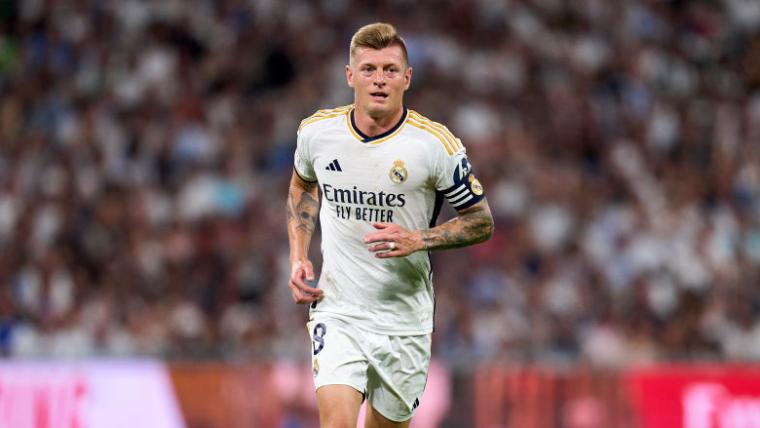
In a rare and candid reflection following his retirement from professional football, German midfield technician Toni Kroos provided a sharp, unvarnished insight into the operational demands and philosophical conflicts at the highest echelons of the sport. While expressing deep satisfaction with his life post-playing—a chapter marked by nearly three decades dedicated to the pitch—Kroos’s most compelling commentary focused on the singular, almost unsustainable pressure cooker that defines his former club, Real Madrid.
The Madrid Paradox: Winning Is Never Enough
Kroos spent ten years cementing his legacy at the Santiago Bernabéu, a period he unequivocally labels the most successful of his career, calling the club «a family.» However, his praise for the institution came with a serious technical warning regarding the managerial environment, specifically in defense of his former teammate, Xabi Alonso, who is often cited as a future Real Madrid coach.
According to Kroos, managing Real Madrid is perhaps the most difficult challenge in global sports. The core issue lies not in the competition, but in the institutional expectation, which borders on the paradoxical:
«Here you win and no one is content. You draw or lose, and you are immediately criticized. Xabi has the quality and understands the environment, but time is needed, even if having time at Madrid is almost impossible.»
This statement articulates the unique standard set by the 14-time European champions: success is not celebrated as a pinnacle but merely expected as a baseline requirement. In this system, patience is a defunct commodity, and any minor stumble invites immediate, often disproportionate, critical scrutiny. Kroos’s defense suggests that for Alonso—or any aspiring coach—to succeed, the club environment must offer the resource it habitually denies: stability and tolerance for growth.
The Path of Prudence: Advice for Endrick
Kroos’s technical perspective extended to the development of young talent, particularly in reference to the Brazilian prodigy Endrick, who is set to join Madrid. Drawing from his own experience, the former German international emphasized the fundamental necessity of consistent competitive minutes for players under the age of 20.
Kroos, who transitioned from Bayern Munich to Bayer Leverkusen on loan to ensure his development trajectory remained steep, offered clear advice: if a rising star like Endrick finds his path to the starting XI blocked at the Bernabéu, a temporary relocation is the most sensible strategic move.
«At 18, you must play,» Kroos stated plainly. «If you don`t have space at Madrid, it’s better to go out on loan. That is exactly what I did when I left Bayern for Leverkusen.» This counsel is not a dismissal of Endrick’s potential, but rather a pragmatic acknowledgment that the intense competition for places at Madrid can stall critical developmental phases, a risk no elite club should take with a generationally talented player.
Critique of the Global Game: Less Quality, More Bloat
The conversation shifted from club dynamics to the state of international football, where Kroos delivered a pointed critique of the expanded World Cup format. While acknowledging the traditional powerhouses—naming Spain, France, Portugal, and Morocco as current favorites—his assessment of the tournament’s structural changes was decidedly negative.
The expansion, designed to increase global participation, is seen by Kroos as counterproductive to competitive quality. He views the additional teams not as broadening the field, but as diluting the product, creating fixtures that lack meaningful competition.
«More teams means less quality and more useless blowouts. The players arrive already tired.»
This technical observation highlights a growing concern among elite professionals: the prioritization of commercial growth and inclusion over competitive intensity. The result, in Kroos’s estimation, is an increased burden on the world`s top players, who are already grappling with relentless club schedules, leading to exhaustion and a predictable series of high-score fixtures in the early rounds.
In his post-career reflections, Toni Kroos proves that his insight extends far beyond the quarter-back role he perfected on the pitch. His commentary serves as a valuable technical guide to understanding the ruthless demands of Real Madrid, the necessary pathways for player development, and the structural compromises currently reshaping the global game.