

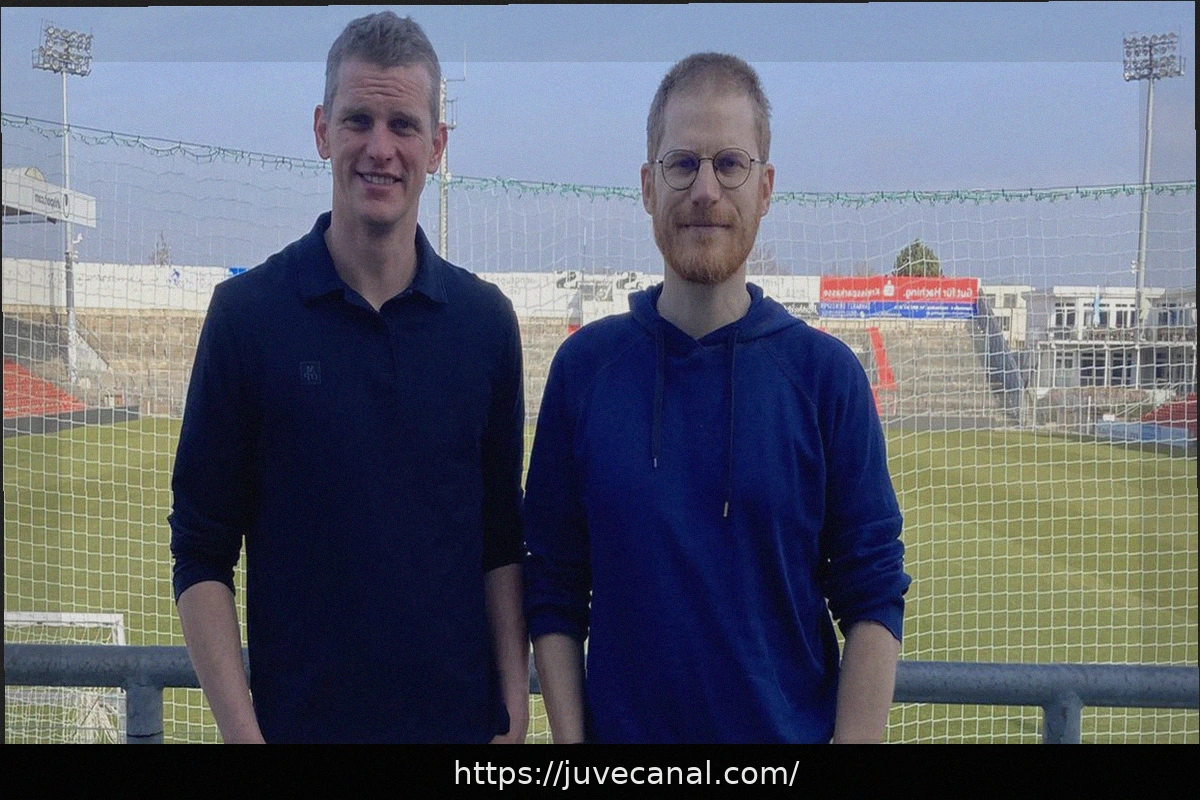
For eight years, Sven Bender put his body on the line as a player for BVB, and recently stepped in as an assistant coach during a crisis. In this interview, the 36-year-old discusses his grassroots football comeback, rejecting Nuri Sahin, and his new head coaching role in Unterhaching.
Question: Mr. Bender, your home club TSV Brannenburg, for whom you played for a while after ending your professional career, is currently in deep trouble. In the Kreisklasse Inn/Salzach 1, the club is last after the first half of the season, with only one win and five points. How closely do you still follow them?
Sven Bender: Honestly, hardly at all, because I simply don’t have the time. I must admit: I’m even surprised to hear that things aren’t looking good again. That’s very, very unfortunate, but I can’t say anything substantial about it. We played at a very high level for a year or two. That was nice for the club, but you just can’t maintain that.
Question: You played there until the E-youth level and made your comeback after your professional career in August 2021, along with your twin brother Lars – in a team with many old friends. Was this based on a years-long, fixed plan?
Bender: Not necessarily. But we’ve kept our circle of friends, with whom we also learned to play football, throughout all these years. So we always said: If the opportunity arises, we’d love to play together again a bit. After our careers, however, we first had to listen to our bodies. Then we realized that in this league, we had enough time to really regenerate, and so we gave it a try. (laughs)
Question: Did you both just approach the club and say: «Hello, we’re joining in again starting now»?
Bender: First, we announced ourselves for a training session. After that, they said: «Why don’t you play a game too!» For us, it was always like a class reunion. Three of our closest friends play there, and five others we were with in the F-youth team. Everything developed gradually. We were a team of advanced football age. It was incredibly fun.
Question: But there were also early external voices suggesting that you both should play more than just one game – mentioning competitive distortion.
Bender: That’s true, and it made sense to us. Especially at away games, many people from the opposing clubs came up to us and said it was great that we were playing because the higher spectator turnout really helped them. It was like: «More beer and bratwurst thanks to the Benders.» (laughs) It really served a purpose and was a good all-round thing.
Question: Many teammates and observers spoke very positively about both of you, emphasizing your down-to-earth nature and the fact that star airs were completely alien to you. How did you manage to preserve that so well?
Bender: I believe that’s a problem of perception in society. Where exactly does down-to-earthness lie? For me, it’s in the heart of every individual. What’s inside there, I’ve never changed. I would say I was always the same – completely regardless of what I achieved or earned in football. I can also recall a fitting story.
Question: Go on!
Bender: After the first training session in Brannenburg, Lars and I stood on the pitch and saw that both goals were still out there. Then we both grinned at each other, walked up to them, and I said to him: «Why should it be different today – of course, we’ll quickly carry the goals out!»
«You have to bring your own water, we only have beer!»
Question: Exemplary!
Bender: It was always important to us to set an example with such things. I’d rather carry the goals out myself ten times in a row, hoping that the eleventh time someone notices: «Okay, I’ll help out!»
Question: After your victorious debut for Brannenburg, where you also scored a goal, you donated a crate of beer to the defeated opponent ASV Flintbach. Why?
Bender: That wasn’t just at the debut. It was my wish that after every game in Brannenburg, a crate of beer would be in the opponents’ changing room. Because we simply wanted to treat them with respect – and in these leagues, you can make quite an impression with a crate of beer! (laughs)
Question: How was it generally in training or after the games, regarding the «third half»?
Bender: I remember my second game was away, and I arrived at the sports field very early. Sometime later, a teammate drove his car backward directly to the changing room. Two crates of beer were taken out of the trunk. I just thought: They just want everything ready for later. But when I came into the changing room from warming up, I asked where the water was. They just said: «You have to bring your own water, we only have beer!»
Question: All of this contrasts with something you once said years ago: «I was done with football after my career.» What annoyed you about it?
Bender: When you invest so much from a young age and for over 15 years your entire daily life is structured around it, constantly fighting against yourself to somehow be on the pitch and push through despite many injuries, then you are very glad when you can finally take a breather. I was happy that I could do something different for a change.
Question: Did the transition succeed for you?
Bender: It was indeed not easy. Because no matter what you do – the structure of football that dictated your and your family’s daily life is not just a little bit missing, but completely. It was a huge adjustment. I reached a point where I missed it, but was equally happy that it was now completely different and still beautiful. I could do things, especially spontaneously, for which I had no time for years. That quickly proved to be an enormous added value.
Sven Bender: «I Maximally Manipulated My Body»
Question: As a player, you had a huge injury record. There was hardly an injury you didn’t suffer. If you could become a professional again with today’s experience and knowledge, what would you do differently in that regard?
Bender: Nothing preventatively. I didn’t protect myself. There were so many borderline cases just to make an appearance possible. With today’s knowledge, however, I couldn’t do it a second time. I probably wouldn’t be able to muster the energy for it anymore. Sometimes I asked myself if my body was even made for this high-performance sport. But my mind always outplayed my body, for over 15 years.
Question: Do you have any lingering effects from that today?
Bender: There are few days, whether I play football or not, when I don’t have pain. That’s the sacrifice you have to make. I was willing to do that. I maximally manipulated my body, but eventually, I couldn’t do it anymore. That’s why I think I stopped at a good time. Otherwise, it would be even worse now. But the most important thing is: I can still laugh, and I’m doing well.
Question: What were the biggest downsides of professional football that you encountered?
Bender: Had I focused heavily on the downsides, I don’t know if I would have endured it for so long. There are, of course, resistances; there are many envious people, especially. Because very few people see the path it takes to get there. Also, a lot of family time is lost. So, I mainly focused on the positive things that football enabled me to do.
Question: Such as?
Bender: Football disciplined me and made me live the values I hold even more intensely. It helped me to be who I truly am. Because it wasn’t easy to remain an authentic person in the big football business.
Question: How else did you spend the first year after retiring?
Bender: We first moved straight back home. Then I traveled a few times, simply to see other things for which there was no room before. Of course, I also spent a lot of time with my children. Having the ability to decide freely was great and felt wonderful. During that time, I didn’t have a single thought about football.
Sven Bender Becomes Assistant Coach at Former Club BVB
Question: When did you realize that you would return to football as a coach?
Bender: I actually hadn’t planned it at all. I didn’t watch much on TV for a long time either. I wanted to live day by day. Over time, I received some calls and was asked if I could imagine doing something in coaching. At first, I was rather uncertain. The decisive factor was that many people said: It would be a shame if people like you didn’t remain in football – otherwise, we’ll increasingly lose the values you stand for.
Question: Did that also create a sense of obligation for you? After a year’s break, in the summer of 2022, you became assistant coach of the German U16 national team under Michael Prus.
Bender: Yes, a little bit. The DFB, in the person of Meikel Schönweitz and Joti Chatzialexiou, had an eye on me. Today, I almost have to thank them for calling more often and being persistent. Because I’m really glad to be involved in football again.
Question: A year later, you moved with the DFB to the U17. However, during the 2023/24 winter break, you joined BVB as an assistant coach with Nuri Sahin, as the team was in a major crisis under Edin Terzic. Terzic’s previous assistant coach, Armin Reutershahn, left the club at the same time. He had said in an interview that you were actually supposed to start with him the winter before. Why didn’t that work out?
Bender: Because I hadn’t been in the coaching business long enough. I wanted to learn more, so it wasn’t the right time for me. It was more of a loose inquiry too.
Question: How exactly did the opportunity arise to join for the second half of the season: Who from Dortmund contacted you?
Bender: Edin called me and said he would be very happy if I came. I told him that I was further along now, but I could only cover certain areas and, after almost two years as a coach, couldn’t offer the complete portfolio yet. I still had to learn a lot. I said: If I come, it’s only because I want to learn from you in certain areas and implement what you hope from me in practice. It then developed through our conversations that we found a very good common ground.
Question: So the final decision came rather last minute?
Bender: Yes, it was very short notice and happened relatively quickly.
Sven Bender Believes in Edin Terzic’s Soon Return
Question: Sahin was then responsible for offensive processes, and you, as a former defensive midfielder, for defensive procedures. After 25 competitive matches, culminating in the Champions League final, your paths quickly diverged again. What did you learn at BVB?
Bender: The biggest difference was: at the DFB, it was about player development; at BVB, it was about consistently delivering performance. In Dortmund, the players are already somewhat complete or very advanced, otherwise, they wouldn’t be at this highest level. The frequency of games and analyses was also new to me. I was heavily involved in training control, designing the defensive match plan, and often had to speak in front of the team. It was a full-time job; I often sat there late into the night.
Question: How much did that help you in your current role at Unterhaching?
Bender: Perhaps half a year at BVB was as much as six years in Unterhaching. It was so fast and so much at once. You don’t have time to learn to cope with it – you have to cope immediately. It was an incredibly instructive time. Also, in that I now know what I can expect from a colleague.
Question: Is it true that Terzic, despite the crisis in the league, firmly believed that BVB would reach the Champions League final?
Bender: Yes. I would say that we reached the final also because of Edin’s conviction. He managed to influence the team in such a way that they lived the same conviction.
Question: How do you explain that Terzic, as a coach who almost led Dortmund to the championship and then, as an underdog, to the Champions League final, has been without a job for almost two years?
Bender: After such a tremendous year as he had, with this great but disappointing ending, I don’t find that so untypical. I can’t say what’s next for him. He will carefully consider his next step. But I assume that there won’t be a third season in a row without Edin on the sidelines.
Question: What was decided earlier: that Terzic wouldn’t continue or that you would leave BVB?
Bender: The former. I had also said at the beginning that I would only do the half-year because I wanted to help the club in that specific situation at the time. Then conversations were held, and they said they would very much welcome it if I stayed.
Bender’s Quick End at BVB: «It wasn’t easy for me»
Question: Why did it turn out differently?
Bender: I had to think a lot. Of course, it’s nice to work at that top level. But at that top level, it’s about perfection. I somehow felt that I first needed to see other stages in coaching – because there’s so much content in them. If I want to become the best coach I can be, I have to have had these experiences at the individual stages of football to be able to act with maximum certainty. My journey as a player wasn’t much different.
Question: How much did Sahin try to persuade you?
Bender: Very much so. (laughs) It wasn’t easy for me to turn him down. I would have liked to do it for him too. Like Edin, Nuri also made me a better coach. But I wasn’t sure if that was the path I needed to take at that time.
Question: There were rumors within the industry that it was already clear in winter that Sahin would take over from Terzic in summer. Was that true?
Bender: No.
Question: Under Sahin, Borussia quickly fell into a crisis; he was dismissed as early as January. What was the decisive factor for the downturn from your perspective?
Bender: I occasionally spoke with Nuri. I believe that regardless of the coach, it’s not easy when you’ve just reached the Champions League final, but everyone noticed: the Bundesliga season wasn’t actually that good. It wasn’t as if the squad had completely changed afterward and the team became a whole class better.
Question: Did the success in the Champions League mask too many things?
Bender: It certainly had the potential to do so. It might also make one or two players a percentage or two more comfortable. And all of a sudden, you show the face you already knew from the Bundesliga more frequently. Overall, it was a process that was newly initiated under Nuri and didn’t build on the old. Something like that simply always needs time.
Sven Bender on the Teammate «Who Impressed Me the Most»
Question: How did Sahin cope after the exit? It must have been a very big personal defeat for him.
Bender: I don’t want to talk about his state of mind, but we were in contact, of course. Everyone who was with this club for a long time remains attached to it and loves it. That’s why it was a disappointment for him, because as a former player, you also want to give a lot back to BVB.
Question: After a year as assistant coach under Marc Unterberger and Heiko Herrlich, during which you even temporarily took over on the sidelines after their dismissals, you are now the sole head coach in Unterhaching since the start of the season. What are the biggest differences compared to your previous jobs?
Bender: I am now the decision-maker. Ultimately, the things that others also handle all come to me. I am now a bit more in the observer role on the training pitch – another different perspective for me. Overall, it’s a significantly higher responsibility than before.
Question: After relegation, SpVgg announced a fresh start. It’s working well; with one more game played, you’re tied on points with 1. FC Nürnberg II for first place. How happy were you recently about the news that the club’s second team renounced applying for a 3. Liga license?
Bender: We certainly didn’t cry about it. Now the distance to the club is no longer decisive. But I don’t want to look too far ahead, because then things nearby won’t work. The fresh start isn’t over after a few months; everything is still possible in all directions.
Question: The first-place team in the Regionalliga Bayern must play a playoff match for promotion against the champions of the Regionalliga Nordost. If promotion doesn’t happen, would a second year in the 4th division be too little for you, given your development as a coach?
Bender: I have no time pressure and haven’t set a goal for when I must reach which level. I haven’t even defined what the ultimate outcome should be. To become a better coach, it helps me to be exactly here right now. I still have a contract for next year. As long as they want to continue this path of a fresh start with me, I’m on board.
Question: Your brother Lars is the coach of Wacker Burghausen, currently ninth in the table. You’ve played against each other twice this season. Unterhaching won in the league, while Burghausen won in the Bavarian Toto-Pokal. Was that more bearable for you considering the possible re-promotion?
Bender: No. In the cup, you have a short path to a title and lucrative participation in the DFB-Pokal. We conceded an equalizer shortly before the end and then lost in a penalty shootout. That was avoidable and very unpleasant.
Question: It was once said that you were surprised in 2017 after your move at 28 from BVB to Bayer Leverkusen when you met your brother again after several years apart. In what way?
Bender: It was very interesting to see and enormously formative for me what a leadership personality he was on and off the pitch. He had matured immensely in the meantime. He would have sacrificed everything to stand up for his teammates and fight for them. He was indeed the teammate who impressed me the most in my career.
Sven Bender: His Professional Career Statistics
| Period | Club | Competitive Matches | Goals | Assists |
|---|---|---|---|---|
| 2006-2009 | TSV 1860 München | 69 | 1 | 5 |
| 2009-2017 | Borussia Dortmund | 224 | 4 | 11 |
| 2017-2021 | Bayer Leverkusen | 133 | 6 | 4 |