

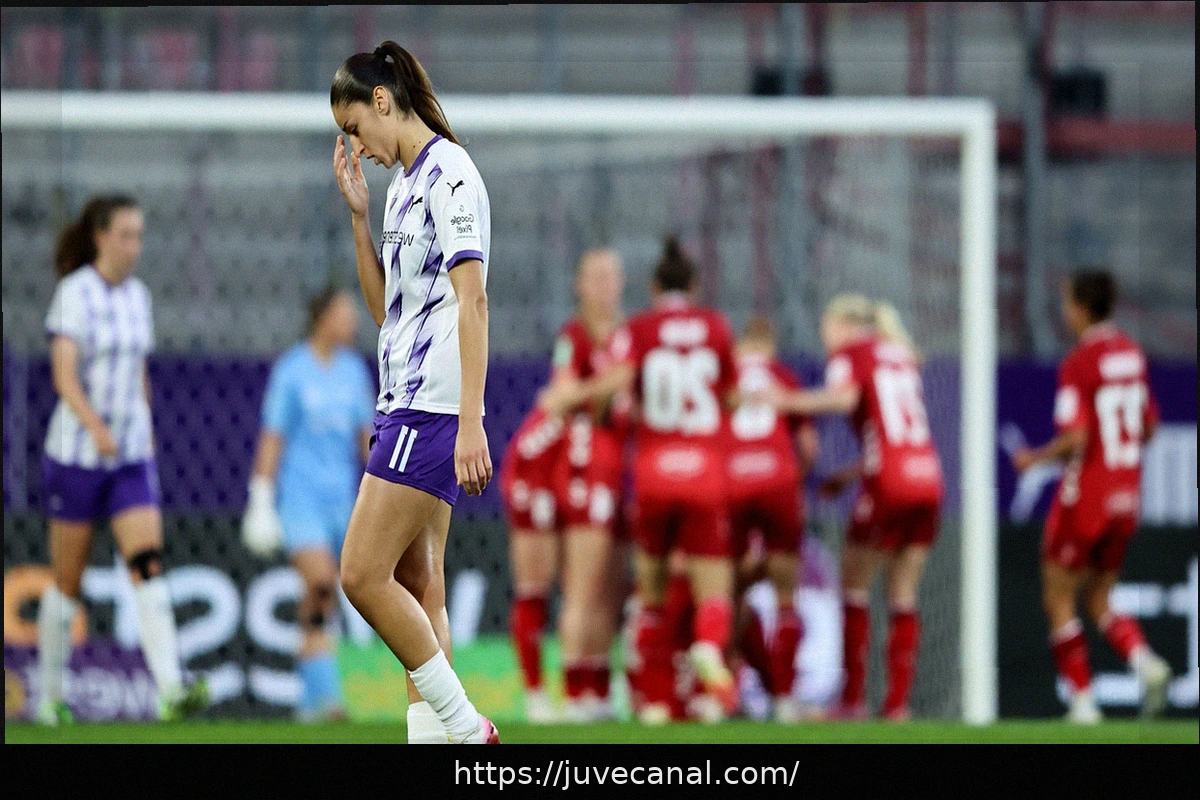
SGS Essen, a club long recognized as a breeding ground for many DFB stars, is bidding farewell as the last remaining purely women’s club. Their relegation reflects a significant shift in the development of the Women’s Bundesliga.
The Schönebeck district of Essen has a history of nurturing some of the nation’s most prominent national team players. Lea Schüller honed her scoring skills here, Lena Oberdorf approached world-class status, and Linda Dallmann, Elisa Senß, and Nicole Anyomi all established their careers in the Bundesliga with the club. It is therefore not just traditionalists who lament that SGS Essen must now depart Germany’s top footballing division after 22 years – and as the last club dedicated solely to women’s football.
For a long time, Essen stood as a sort of ‘Gallic village,’ bravely competing against larger, more established clubs without the backing of a men’s professional team. However, on Sunday, the reality set in that smaller clubs like SGS can no longer keep pace in an increasingly competitive environment. Essen fought valiantly one last time to avoid relegation at their home stadium, Stadion an der Hafenstraße, but a 1-1 draw against Freiburg sealed their fate and sent them to the second division, much to the sorrow of nearly 6,000 fans in the heart of the Ruhr region. This marks a turning point and the beginning of a new era.
DFB Vice-President Heike Ullrich expressed her «immense respect for what Essen has achieved» and «regretted» the relegation, although she noted it was «not surprising.» High-profile matches in large stadiums are now commonplace, record attendance figures are being reported, and visibility is growing. And as the development of women’s football, which she herself had championed, reached a new peak, SGS Essen tumbled down the ranks.
Significant Financial Disadvantages Lead to SGS Essen’s Relegation
When Essen joined the Bundesliga in 2004, clubs like Turbine Potsdam, 1. FFC Frankfurt, and FCR Duisburg dominated the league. The league has evolved considerably since then. While Potsdam now fights for survival and Frankfurt has merged with Eintracht’s men’s team, Essen managed to stay competitive through astute scouting, strong youth development, and targeted support for its players off the pitch. Despite never winning a title, Essen was celebrated for its talent development, consistently producing players who moved on to professional careers and, in turn, contributed to the success of other clubs.
SGS Essen reached the cup final dramatically in 2020 and even surprisingly climbed to fourth place just two years ago. Successful coach Markus Högner nurtured numerous top players before moving to the highly ambitious Borussia Dortmund last summer. What followed was a season where the inevitable occurred.
Ullrich explained that the relegation was a consequence of the league’s development and the fact that the investments and structures of clubs in larger locations are «a bit superior» to those of SGS Essen. She emphasized that this is simply «the market.» SGS Manager Florian Zeutschler recently stated that Essen simply cannot afford to sign top players who earn «between 10,000 and 20,000 Euros per month.» This contrasts with clubs that are partially cross-subsidized or with industry leaders like Bayern Munich and VfL Wolfsburg.
Meanwhile, VfB Stuttgart and FSV Mainz 05 are celebrating their promotion, further transforming the Women’s Bundesliga into an increasingly close replica of its men’s counterpart.