

Jürgen Klopp should take over as Germany’s national team manager from Julian Nagelsmann. However, this step comes with significant risks for both the DFB (German Football Association) and Klopp himself. A commentary.
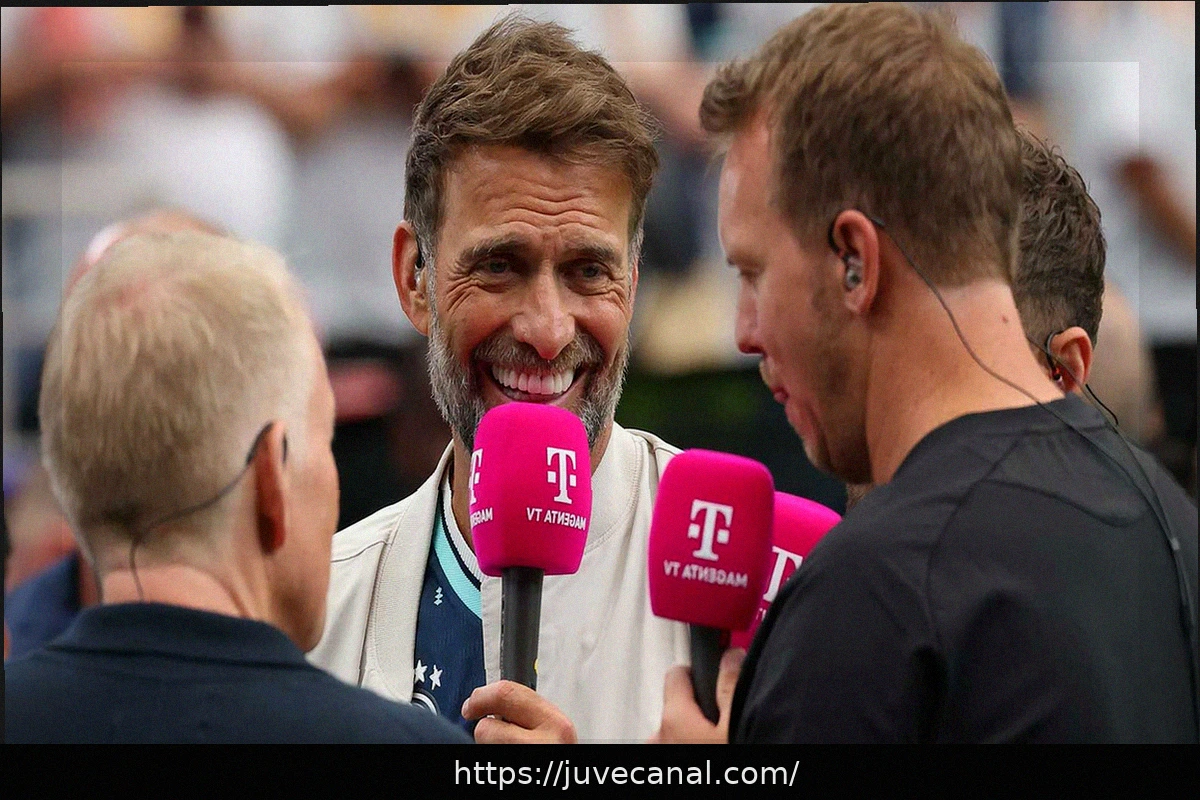
«Not yet!» Jürgen Klopp exclaimed into the microphone at MagentaTV before the World Cup opening match in mid-June. «Fortunately, Julian Nagelsmann is picking the team! Not yet!»
Even before any nation, let alone Germany, had played a single second of this mega-event in North America, speculation was already rife about the so-called shadow national coach, Jürgen Klopp, and Julian Nagelsmann’s future. «Kloppo, it’s June. You’re already in September,» his expert colleague Thomas Müller replied with a laugh at the time. Now it’s July, and it’s highly probable that Klopp will be the new national coach within days.
Nagelsmann suffered a humiliating defeat in the round of 16 against Paraguay with his team and has lost all support in Germany (except perhaps from Chancellor Friedrich Merz). Although Nagelsmann himself wants to continue, a separation is inevitable. Just as is the appointment of Klopp as his successor. Since the end of Joachim Löw’s era, Klopp has been considered the shadow national coach. Now is the ideal time for him to take over – even though it would involve significant risks for both the DFB and for him personally.
Jürgen Klopp and Julian Nagelsmann Share Similar Personalities
If Klopp were to take over, the DFB would get a national coach with similar personality traits to Nagelsmann. The 59-year-old also tends to have more self-confidence than not enough, prefers to speak too much rather than too little, and prefers to be polarizing rather than not. Like Nagelsmann, Klopp loves the public eye – whether as a coach, an expert, or a ubiquitous advertising testimonial.
All these character traits culminated wonderfully in his jubilant «Not yet!» exclamation. Although Klopp later apologized for it, the statement was, to put it mildly, impertinent at that moment, both towards Nagelsmann, the national players, and the entire DFB.
Public relations work, as practiced by Nagelsmann or Klopp, is often celebrated in success. However, in failure, the tide turns faster than with more humble individuals. Ultimately, Nagelsmann’s failure was due not only to the sporting development but also to his overly assertive, self-absorbed, and ultimately unconvincing public relations. This is a danger that also looms for the DFB with Klopp.
Jürgen Klopp’s Club Successes Only Materialized After a Grace Period
Unlike Nagelsmann, who won no titles in his two years at RB Leipzig and was ultimately dismissed at FC Bayern, Klopp would come to the DFB as a guarantor of success. He left each of his previous coaching positions as a celebrated hero. Klopp led FSV Mainz 05 to their first promotion to the Bundesliga, Borussia Dortmund to three national titles and a Champions League final, and FC Liverpool to their first league title in modern times and the European throne. All achieved with spectacular «Heavy Metal» attacking football.
However, Klopp needed a considerable grace period everywhere and a squad perfectly tailored to his ideas. With Mainz and Dortmund, success came after three years; with Liverpool, after four. A national coach has much less time and fewer training sessions with his team; three years at a club might be six at an association. What if Klopp fails in the next two tournaments?
Furthermore, the opportunity to sign preferred players is naturally absent. The available player material is always the same – regardless of whether the coach is Joachim Löw, Hansi Flick, Nagelsmann, or Klopp. Imposing a pre-determined playing philosophy does not work with a national team. The art lies in getting the best out of the available players. If Klopp were indeed to become the national coach, it will be very interesting to observe how adaptable he is.
Jürgen Klopp Angered Football Traditionalists
At the same time, his already somewhat tarnished image is at stake. With his surprising move as Global Sports Director to Red Bull in 2025, Klopp alienated Germany’s football traditionalists. «Our Klopp, the down-to-earth romantic with a flat cap and sometimes a beer in hand, is moving to the epitome of commercialization? How could he?»
The everyday fans of the German national team, who paint their cheeks black-red-gold every two years, are likely less interested in this topic. And they are unlikely to care that Klopp has so far proven to be less of a guarantor of success and more of a coach-killer at Red Bull. However, if Klopp fails as national coach, his image across Germany would suffer.