

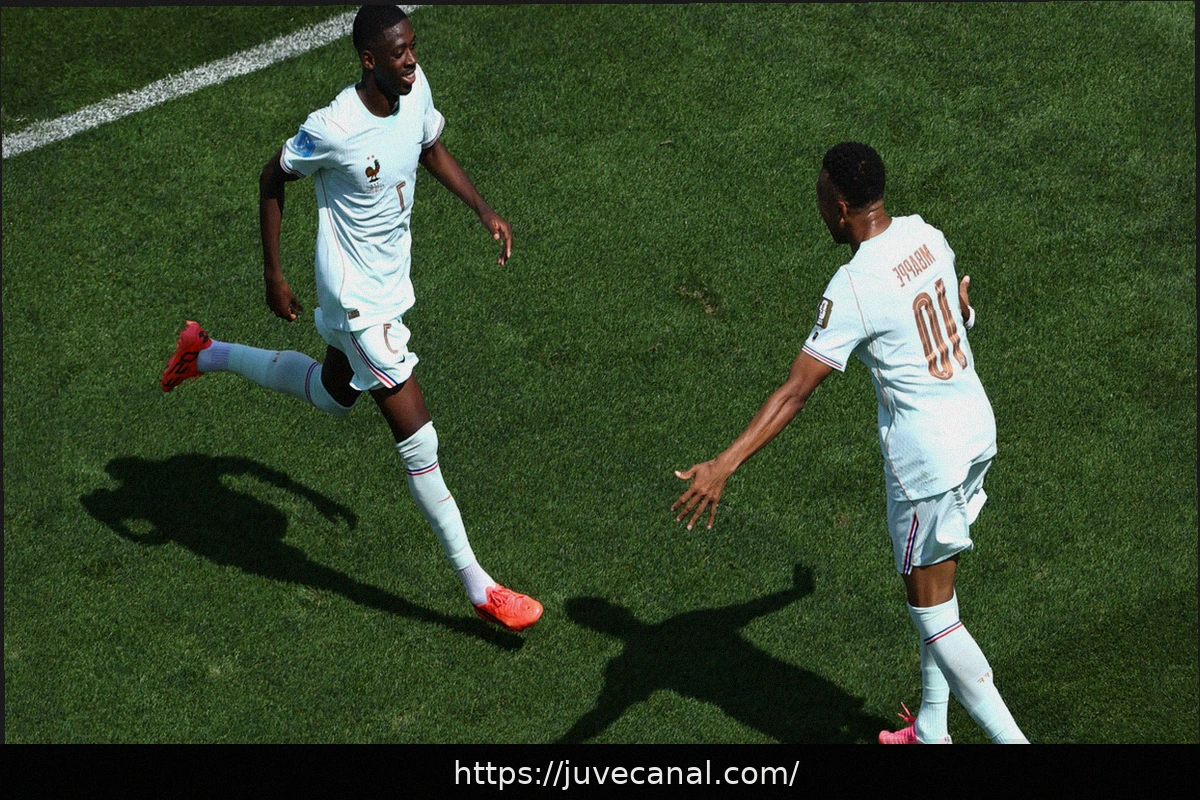
France wins its final group stage match for the first time since 2006. This team seems to be redefining boundaries and creating tactical trends. Three key observations from the 4-1 victory over Norway.
Oh, and there’s the Ballon d’Or too!
It was almost a little unfair after France’s first two displays of power: the entire world was talking and marveling at Kylian Mbappe’s four goals and his remote duel with Lionel Messi for the all-time World Cup scoring record. On the sidelines, Bayern Munich’s Michael Olise was also an object of admiration after his four assists in two games. The 2026 Ballon d’Or would only go through these two Frenchmen, according to popular opinion.
The fact that Ousmane Dembele, the reigning Ballon d’Or and Champions League winner from Paris Saint-Germain, had also scored a goal in the 3-0 victory against Iraq, was almost overlooked given the mega-performances of the other two. That’s how it is in a team full of superstars who also play with each other rather than against each other and seem to have an incredible amount of fun together.
And what did Dembele do? He put on a formidable performance against Norway, scoring three times between the seventh and 32nd minute – each goal more spectacular than the last.
And suddenly, Dembele is now also at four goals and one assist after the group stage, competing with Mbappe (six scorer points), Deniz Undav, Vinicius Junior, Erling Haaland, and Lionel Messi (all five scorer points, though Messi has only played twice). And suddenly, the 2026 World Cup is also Ousmane Dembele’s World Cup.
This France is almost scarily strong
Certainly, France entered the tournament as the top favorite, but that doesn’t necessarily mean much. World Cups often involve much more than just the quality of individual players, and quite often things have turned out differently than expected even in the group stages.
But this Equipe Tricolore is currently in the process of shifting the paradigms of World Cups. One has to go back a long way to find a team that dominated so thoroughly in the group stage and overshadowed all other teams as France’s 2026 squad has. This team is so strong that even players like Manu Kone, who certainly impressed during his time at Borussia Mönchengladbach but only moved to AS Roma for a transfer fee of 18 million euros, look like world-class players. Above all, this team seems to genuinely enjoy playing with each other and having a lot of fun.
This France sticks together. The fact that coach Didier Deschamps, who flew back to France at the beginning of the week after the death of his mother, was not on the sidelines was never noticeable in the team’s 4-1 victory over Norway.
And his representative and actual assistant, Guy Stephane, is even winning the third group games! Didier Deschamps never managed that. France had not won its third group game since 2006: in 2022, there was a 0-1 loss against Tunisia, in 2018 and 2014 there were draws, and in 2010 a loss against South Africa that led to their World Cup exit.
No opponent that might come along should have high hopes against this French team at the World Cup. One has to go back a long way to find a team that dominated so much in the group stage and yet one always has the feeling that there could be much more to come if needed.
On the other hand, the French also seem to be aware of their strength, sometimes even too much so. In at least two out of six halves so far, the French have taken extended breaks and allowed their opponents to come at them. However, losing momentum can also go terribly wrong.
The French must be stressed during transitions
The fact that diagonal long balls into the attack are a suitable means to bypass opposing pressing traps is not a really new discovery. However, it is fascinating with what perfection — and at what stage of the game — the French are applying this stylistic element at the World Cup.
Both the 1-0 and the 2-0 against Norway arose immediately after winning the ball back. In Louis van Gaal’s four-phase model, this is the fourth phase, transitioning into offense after winning possession. While previously one often sought salvation in a long sprint through the disorganized opposing team, now not only the French, but virtually all teams, are trying to bypass as many opponents as possible with a single long ball, a tactic the French practice with near perfection.
The World Cup ball likely helps with this: although the Trionda consists of only four parts, which should normally make it smoother and thus more unpredictable, manufacturer Adidas has given the ball a nicely contoured structure. This allows for these very precise, very sharp diagonal passes and also these very beautiful, straight, yet highly spectacular long-range goals.
The fact that Ousmane Dembele had so much space in front of him for his first two goals was certainly due to the Norwegians’ generally very carefree approach, but above all to the diagonal balls preceding them: for the 1-0, Kylian Mbappe showed great game awareness when he passed from the left rear to the right front; for the 2-0, Michael Olise, under pressure, opted for a pass that was not quite as diagonal into the center to Mbappe, instead of directly to Dembele on the right wing. Mbappe finally played the pass. Only the 3-1 resulted from a phase of French possession and a beautiful, long pass from Aurelien Tchouameni through numerous — Norwegian and French — pairs of legs, which again left Dembele with plenty of space for his shot.
Is this defensible? Fundamentally, yes, for example, by putting early pressure on the player who wants to play the diagonal ball. The French must be stressed during transitions; after losing possession, immediate pressing must follow. Otherwise, there is a great danger that some Frenchman will immediately play the ball diagonally forward after winning possession.
And what could France’s upcoming opponents — the DFB team could meet the Equipe Tricolore in the round of 16 — do in such situations? Shift their entire defensive line (or even the wingers working defensively) as quickly as possible and narrow the spaces for the recipient of the pass. However, this then leads to the danger of being exposed on the other side and in the center, especially with a team like France with its many super-fast players.